Brian May and Adam Lambert of Queen, 2023Queen was one of the most successful rock bands of the 1970s and 1980s - both in the studio and on tour. The quartet of Freddy Mercury, Brian May, Roger Taylor, and John Deacon sold out arenas worldwide. Mercury passed away in 1991, and Deacon retired shortly afterward. But May and Taylor recruited Adam Lambert a decade ago and revived the band. This year's tour brought Queen to the United Center for two nights. I attended the first show on Tuesday evening.

For an hour before the Queen concert began, the stage was blocked by a screen containing a projection of a 3-D crest, like the ones that graced the band's famous "Night at the Opera" and "Day at the Races" albums. The crest was set against an animated clockwork. As the show began, the music grew in volume, and metallic beings started to climb through the clockwork mechanisms until the screen became translucent, then transparent, then elevated to reveal the band, which launched into a medley of "Radio Ga Ga" and "Machines (Or Back to Humans)."

It was a high-energy moment, and the band maintained this energy throughout the evening, performing for over two hours in front of a sold-out arena.

Freddy Mercury was a flamboyant character with an impressive vocal range and a larger-than-life personality. Mercury's death in 1991 effectively ended the band's initial run. When the band revived in 1991, they recruited vocalist Adam Lambert. Like Mercury, Lambert is a flamboyant character with an impressive vocal range and a larger-than-life personality. He does not channel Freddy as much as he draws inspiration from him.

One comes to expect impressive light shows at an arena concert, and this was no exception. The lighting and the video images morphed impressively with the music. But we also saw many practical effects and props. Brian May performed a guitar solo as he was elevated above the stage and as astronomical images swirled about him while spheres descended from the ceiling; Adam Lambert performed "Bicycle Race" while sitting on a chrome motorcycle; Leaves falling from the ceiling augmented a giant video of an autumn tree.

The show also presented some video images of the band: 72-year-old Roger Taylor's drum solo followed a video of him performing a timpani solo in his twenties; the music video of "Bohemian Rhapsody" accompanied the band's performance of their operatic composition; And videos of Freddy Mercury performing brought the crowd to a frenzy.

But it was the music that made the show.

The band performed some deep album cuts (my favourite was Brian May accompanying himself on acoustic guitar, while singing the sci-fi folk song "39"), but they dedicated most of the set list to their hits, including "Another One Bites the Dust," "Fat Bottomed Girls," "Killer Queen," and "Don't Stop Me Now."

They could have ended the concert with "Bohemian Rhapsody" rather than ending the first set with that song. Instead, they returned to the stage for three more songs, ending with "We Are the Champions" - an anthem that carried Queen during their heyday.

This version of Queen still has the power to electrify audiences.


GCast 161:

Sorting a Microsoft Word Document by Headers [GCast 161]

Learn how to sort the contents of a Microsoft Word document by the headers in that document


Episode 773

Cameron Turner on Predictive and Generative AI

Kin + Carta Vice President Cameron Turner discusses how his company approaches Artificial Intelligence solutions for their customers. He talks about the kinds of solutions, how to use data, and ethical considerations.


I set aside my friend Paddington Bear for a year before returning to him this week when I picked up one I had not yet read.

"Paddington Takes the Air" is another charming collection of stories about the anthropomorphic bear who means well but always inadvertently causes trouble. In this book, he enters several competitions for which he is unsuited but at which he miraculously does well.

He enters a horse-riding contest and enters the ring with a professional wrestler. The final two stories tell of Paddington's invitation to a ball, his attempts to find the proper clothes and his dance contest at the event.

In other stories, the bear takes a trip to the dentist, attempts to mend the clothes of his neighbor, and attempts to solve a crime as an amateur detective.

Paddington was born in darkest Peru but now lives with the Brown family in London. His stories continue to bring a smile to my face.


Justin Hayward 2023Before I talk about Justin Hayward's performance Monday evening at Chicago's City Winery, I want to talk about Mike Dawes. Dawes performed a solo warmup act before Hayward's show. He is a guitar virtuoso who uses every bit of the instrument, moving his fingers and palms up and down the entire neck of the guitar to make his six-string sound like multiple twelve-strings. If you have a chance, he is worth seeing perform live.

Dawes was part of Justin Hayward's band during the main act, along with keyboardist Julie Ragins and flutist Karmen Gould, who all provided vocal harmonies.

Justin delighted the audience by opening his show with "Tuesday Afternoon" - a big hit for the Moody Blues. Justin was the lead vocalist and frontman for the popular progressive rock band. He played some of his solo compositions this evening, but the audience was most excited to hear the Moody Blues classics. Justin did not disappoint, performing "The Voice," "Never Comes the Day," "Your Wildest Dreams," and "Question." With each song, the crowd burst into cheers upon recognizing the opening chords.

When Hayward sang a beautiful version of the mega-hit "Nights in White Satin," we assumed that would close his show, but he remained for two more songs. He extended his set beyond two hours rather than leaving and returning for an encore.

At 77, Hayward still retains an impressive vocal range, and the music he made famous with the Moody Blues tested that voice this evening.

He impressed me and the sold-out audience.


I had a chance Friday to volunteer at the STEAM Hack-to-Learn. The event was held at the Chicago downtown Microsoft office.

The event brought in students from suburban Chicago and featured several guest speakers, as well as hands-on activities.

Jeff Gettis opened the event, describing his journey from Chicago's south side to his 20 years at Microsoft.

Jon Browning, CEO of Global Mentorship Initiatives, spoke about the importance of networking in building your career, pointing students to LinkedIn and ChatGPT as tools to help them in a job search.

Author Gayle Keller hosted a panel of industry professionals who answered questions about professional careers.

Ravi Penmetsa gave an overview of Artificial Intelligence.

The talks were all interesting, but I was most impressed by the kids' questions, which showed a genuine curiosity about a career in IT. They asked questions like "What is the most interesting part of your job?" and "What would you be doing if you were not in this field?"

After the presentations, the students broke into teams and rotated between building applications with low-code and no-code tools and learning to dance to K-pop music.

At the end of the day, each team stood at the front of the room and shared what they learned.

It was an excellent chance to experience young people learning something new.


Episode 772

Jon Skeet on Enhancing His Church's A/V System

In his spare time, Jon Skeet has been helping his church improve its Audio and Video production. He talks about the "Zoom and Enhance" and "At Your Service" applications he created to control audio and video, control cameras and displays, translate speech, and allow people to participate in the service from home.

Links:
https://tinyurl.com/at-your-service


SteepCanyonRangersNorth Carolina bluegrass band Steep Canyon Rangers performed two shows Saturday evening at the Old Town School of Folk Music. I attended the second show, which started promptly at 8 PM.

I was in a depressed mood when I walked into the theatre. Never mind why. But the music changed that. Beautiful melodies and tight harmonies brought me back from the precipice.

The Rangers have maintained great stability over their 23-year span. However, Aaron Burdett replaced founding member Woody Platt on guitar and vocals last year. Burdett melded with his new teammates admirably. A remarkable aspect of this six-piece band is that every member is a world-class musician. Each had a chance to shine, whether in a solo or as part of the orchestration, and I saw no flaws. 

With sixteen albums from which to choose, they selected songs like "Be Still Moses," "Afterglow," "Birds of Ohio," and "Fruits of my Labor" - all of which went over well. All their music sounded great, from high-energy to instrumentals to gospel to love songs to sorrowful ballads.

Their version of the Traveling Wilburys' "End of the Line" made me smile.

Music has the power to lift us up when we are down, and the Steep Canyon Rangers did just that.


"Be Mine" by Richard Ford

Comments [0]

I thought we had heard the last of Frank Bascombe, Richard Ford's philosophical everyman.

Ford wrote about Frank when the protagonist was in his 30s ("The Sportswriter"), 40s ("Independence Day"), 50s ("The Lay of the Land"), and 60s ("Let Me Be Frank with You"). Frank has survived two divorces, cancer, a gunshot to the chest, and the loss of a child.

Richard Ford returns to Bascombe's life in his 70s with a new novel: "Be Mine."

Frank's adult son Paul is diagnosed with terminal ALS. With little time left, Paul and his father travel to the Mayo Clinic in Minnesota for experimental treatment; then embark on a road trip together to visit Mount Rushmore. Paul and Frank have never been close, and this trip is their last chance to salvage their relationship. One problem is that the two are too much alike. Father and son consider themselves philosophers because they each ask questions about the world. The difference is that Frank asks most of his questions silently, while Paul tends to blurt out whatever crosses his mind. Paul is angry at his father for years of neglect, and his comments shift from unfunny jokes to obnoxious sarcasm. Ford may be challenging the reader to feel sympathy for an unlikeable character who happens to be dying; or we may be seeing Paul through the filter of Frank's perceptions as he tries to alleviate the guilt of being a poor father. Regardless, it makes for an uncomfortable dynamic.

Like the previous four volumes in this series, "Be Mine" is Frank's narration and philosophy told from inside his head as it occurs.

Ford gives a wink to the fourth wall with lines like "We think what people write down in their private moments will always reveal crucial evidence of their innermost selves. Only, what goes on in anybody's head is rarely worth knowing." It is ironic, given the stream-of-consciousness style of the novel.

Also, like the previous novels, the incidents of this novel take place over a few days around a holiday. In the past, it was Easter ("The Sportswriter"), Independence Day ("Independence Day"), Thanksgiving ("The Lay of the Land"), and Christmas ("Let Me Be Frank with You"). "Be Mine" takes place around Valentine's Day, allowing the cynical Bascombe family to voice their opinions on a sentimental holiday. And like the earlier books, the plot takes a back seat to characters and their musings.

Every decade, Richard Ford revisits his most famous protagonist, who ages at about the same rate as his creator. There is no guarantee that we have seen the last of Frank Bascombe. But, if so, this is as good a send-off as any.


I recently passed the Microsoft AI-102 exam.

This exam primarily covers Azure Cognitive Services, such as Computer Vision, Text Recognition, Speech Recognition, Language Understanding (LUIS), and the Bot Framework.

My primary study tool was the [self-study guide on Microsoft Learn](https://learn.microsoft.com/en-us/credentials/certifications/exams/ai-102/). I spent about an hour a night on this for about a week. I have used most of the services already, but many I had not used in years.

Although the exam covered all areas, I received a disproportionate number of questions about the Bot Framework and LUIS.

The exam covers nothing about Open AI, ChatGPT, or Codespaces. I expect that Microsoft will soon update the exam to include these newer technologies or create a separate exam.

The exam includes about 45 questions that are either multiple-choice or drag-and-drop. The drag-and-drop questions ask you to select the required steps and sort them. As with most Microsoft exams, you can go back to review a question and change your answer if you want.

The question count displays at the top, along with the time remaining (I think I was allowed 2 hours total). But the question count is misleading. After completing the questions, a case study was displayed, followed by a series of about six questions related to that study. In this section, you are not allowed to go back to review or change an answer. You are permitted to reread the case study. The case study contains a lot of information, and not all of it is relevant to the questions, so this section is as much a reading comprehension test as anything else.

Here is my advice to prepare for the exam.

Review the training materials. Schedule time each day to study them.

Open the Azure Portal and try out each service described in the training materials. Poke around and become familiar with the various options.

Take the exam shortly after finishing the training.

Make sure you allow enough time for the case study at the end.

Get a good night’s sleep before the exam. You will need to focus your mental energies.

Good luck.


Episode 771

D'Arcy Lussier on Microsoft's OpenAI Journey and Strategy

D'Arcy Lussier discusses the partnership between Microsoft and OpenAI, how we got here, what the future holds, and how you can take advantage of the technologies built from this partnership.

Links:
https://top500.org/


Mary Chapin Carpenter and Shawn Colvin at Cahn AuditoriumMary Chapin Carpenter and Shawn Colvin. Shawn Colvin and Mary Chapin Carpenter.

I expected that one would perform as the warmup act and the other (presumably MCC) would be the headliner. But Wednesday night at Evanston's Cahn Auditorium, they took the stage together for a performance lasting over two hours.

Each lady armed herself with a guitar and a voice that remains strong in their sixth decade.

Sometimes, Mary stood in front and sang while Shawn took a seat. Sometimes, Shawn stepped forward while Mary took a break. But they were at their best when they performed together - alternating verses and harmonizing as if they had been singing together for years.

Of course, the old friends have been singing together for decades. It showed in their music, and it showed in their banter. They debated the merits of having a tuning device. They joked about their choice of clothing. And they finished each other's sentences, as old friends do.

Both women are accomplished songwriters, but this evening included their interpretations of many other songwriters. They played the music of folk singers like Steve Earle ("Someday") and Lucinda Williams ("Passionate Kisses"). And they played some surprises, including The Backstreet Boys' "I Want It That Way" and The Beatles' "I'll Be Back". Each song was delivered with the heartfelt passion of two performers who continue to love their craft.

And their music.


Ten years ago today, I began a new journey.

October 14, 2013 was my first day working at Microsoft. My job title was Technical Evangelist. My responsibilities included teaching others about technology and engaging the US developer community. I spent a lot of time creating demos and presentations and delivering them at conferences, user groups, colleges, and code camps. I spent time at startup incubators, showing them how to use Azure to help their business. Microsoft was trying to promote their phone and Windows 8, so I quickly learned how to build applications for these platforms, and I hosted workshops to teach others what I learned.

The job required me to move to Chicago, but it took me across the country. The decision to take the job and move from Michigan was easy. My two sons had just graduated (one from high school, the other from undergraduate university) and moved out of state to continue their education. I had moved to Michigan eleven years earlier only to be closer to them, and that reason no longer existed.

To say this decision was life-changing would be an understatement. The job allowed me to work with amazing people, help others in the community, take control of my life, and get paid for things I was already doing for free.

That role lasted me about 4-5 years before Microsoft decided to eliminate the Evangelism team. It was the best job I ever had. Since then, I have worked in two other organizations at Microsoft. I have learned a great deal at each position.

Two of my favourite things are learning something new and teaching others. My time at Microsoft has allowed me to do a lot of both. I love working with smart people; this company is loaded with them. More importantly, they are almost always willing to share their knowledge with me.

Not every day was perfect. Not every year was great. I have had some great managers and some bad managers, which makes the biggest difference in my job satisfaction and performance. At one point, I came close to leaving the company because a manager actively discouraged collaboration and frequently made up and repeated falsehoods to justify his negative opinion of me. I survived that toxic environment, and I survived the recent round of layoffs.

Last year, I joined the Global Partner Solutions team as an architect, where I help our partners design solutions for their customers. I work with amazing people, and I learn something new every day!

This week, I have a new manager following the promotion of my former manager. The old and the new are good people who care about others, making me optimistic for the future.

I doubt I will stay here another ten years, but I fully expect to be here another five. I wonder if time will pass as quickly as it has since 2013.


GCast 160:

Azure Monitor Diagnostic Settings

Learn about Azure Application Insights Alerts and how to create and manage them.


Episode 770

Nisaini Rexach on AI in Education

Nisaini Rexach discusses the impact Artificial Intelligence has had on education, and how the educational system can adapt to rapidly-evolving tools.


Elizabeth Strout introduced us to Olive in her 2008 novel "Olive Kitteridge," for which she won the Pulitzer Prize.

Olive returns in "Olive, Again." Like the first book, this one consists of a series of short stories - some focused on Olive and some in which she appears as a minor character or only a mention.

This volume focuses more on Olive's life and actions in the fictional small town of Crosby, Maine. She remarried after the death of her husband, Henry. As in the first novel, noteworthy events happen between chapters, such as the wedding and Henry's death.

We see Olive aging (from her 70s to her 80s). Her body deteriorates, but she grows as a person. She begins to recognize the coldness and unkindness she displayed throughout her life. She regrets this and strives to change.

My favorite story was "Helped," about Suzanne - a woman who returned to Crosby after her father's death in a fire. How Suzanne's father acquired her inheritance troubles her, and she contemplates the mistakes in her life and how to deal with them.

Not far behind is "Motherless Child." In this story, Olive witnesses her daughter-in-law publicly scolding her son and realizes she did the same to Henry throughout their marriage. A moment of epiphany sets Olive on a path of redemption.

A few characters appear from Strout's other novels - "Amy and Isabelle" and "The Burgess Boys," which made me want to read these books.

I enjoyed "Olive, Again" at least as much as its predecessor.   


A View From the Bridge

Comments [0]

The cast of A View From The BridgeEddie and Beatrice have raised their niece Catherine since she was orphaned as a little girl. Their life seems happy until they invite two illegal immigrants - brothers Rodolpho and Marco - to stay with them. Catherine has blossomed into a beautiful young woman and falls in love with Rodolpho, which infuriates Eddie. Eddie hates Rodolpho for his effeminate manners and for refusing to ask his permission before courting Catherine. He hates the loss of control of his ward. But mostly, he despises the relationship because he lusts for Catherine.

Shattered Globe Theatre's current production of "A View From the Bridge" brings Arthur Miller's 1955 play to life. The cast was excellent. Isabelle Muthiah brings out the sweetness of Catherine, while Eileen Niccolai shines as the sensible Beatrice. But Scott Aiello steals the show as Eddie. His anger is palpable. He hints at his sexual frustration in Act 1 before it explodes in Act 2. It is rare to see a successful television actor like Aiello (he has appeared as the recurring character Tommy Barkow in the Showtime series "Billions") appear in such an intimate setting as Theatre Wit.

As the second act proceeds, the story becomes more tense until it ends abruptly, with an unresolved tragedy.

We left the theatre feeling numb. Nothing was resolved. There were no heroes. There was no justice. No lessons were learned. But perhaps that was the point, as men like Eddie allowed their emotions to overtake their reason.


Peter Gabriel in concert at the United CenterPeter Gabriel was one of the driving forces in progressive rock - first as a founding member of Genesis and later as a solo artist.

At his height, he could master pop melodies, African rhythms, complex arrangements, and ethereal mood-setting pieces. He combined all these in his concert at the United Center on Saturday evening.

His latest tour included a stop at Chicago's United Center Saturday night. Despite a near-sellout, I managed to find a third-row seat the night of the show, where I could experience the performers' emotions up close. Others in the arena settled for the music and a multimedia performance, both of which were impressive. Gabriel's band was enhanced by horizontal, vertical, and round video screens projecting nature, rainfall, people, star fields, rainfalls, and videos set to the music created on stage. Dramatic lighting is a staple of a Peter Gabriel concert, and colorful laser lights often illuminated or backlit the musicians, who were all dressed in black.

The band itself was outstanding. Nine musicians - many of them multi-instrumentalists - accompanied Mr. Gabriel during his 2-hour performance. They combined to play strings, woodwinds, keyboards, and (of course) guitars. Ayanna Witter-Johnson set aside her cello on several songs to show off her angelic voice in a duet with Peter. She filled in admirably for Kate Bush on Gabriel's 1986 hit "Don't Give Up."

Gabriel used the concert to promote his upcoming "i/o" album - his first collection of new music in 21 years. He played most of the songs from the album, discussing each piece with the audience beforehand. He included some songs on which I grew up, but more than half the set consisted of recent music. He delighted the crowd with rousing renditions of "Sledgehammer" and "Solsbury Hill," in which Gabriel showed off some impressive dance moves. But he also inspired the audience with his anthems, including his closing encore, "Biko" - a tribute to South African anti-apartheid activist Stephen Biko. Gabriel skipped some of his big hits, such as "Shock the Monkey" and "Games Without Frontiers," in favor of newer music. But by playing for over two hours, he could accommodate a variety of music.

I discovered Peter Gabriel during my high school days. I would have preferred hearing more of his music from the 1970s and 1980s, but his new album contains some quality compositions with creative arrangements. My only regret is waiting over four decades to finally see him perform live.


I had my first experience with Microsoft certification renewal process this past week.

In December 2022, I took and passed Exam SC-300: Microsoft Identity and Access Administrator. In February 2023, I took and passed Exam AZ-204: Developing Solutions for Microsoft Azure. I spent weeks studying for each of these exams, and I was stressed until the exam ended and I received a passing score.

It was a lot of work, particularly given that the exams are only valid for one year. If I want to keep any certifications associated with the exams, I must renew them before they expire.

The good news is that an exam renewal is much easier and far less stressful than the original exam.

The key parts of a renewal exam are:

  • You can take the renewal exam any time between the expiration date and six months before the expiration date.
  • Once you pass the renewal exam, it extends the expiration one year beyond the original expiration date (not one year from the date you pass, as I feared)
  • Questions on the renewal exam tend to focus on newer features.
  • Unlike the original exam, renewal exams are not proctored. You can take them at home, and you do not need to turn on your webcam.
  • Renewal exams are open book. You are free to use any materials during the exam.
  • As far as I can tell, the exams are not timed. The description for SC-300 says "45 minutes," but I took about three hours for the exam. I did not close my web browser during this time.
  • During the exam, you may not return to a previous question.
  • Renewal exams are free.

Here is the strategy I took for AZ-204. I plan to use this strategy for future renewal exams.

  • The exam recommends training materials. I went through all these materials. It took me 3-4 hours to review all the material, which is far less than the time spent studying the materials for the original exam.
  • I took the exam shortly after completing the training, while it was still fresh in my mind. I started the exam about an hour after I finished studying.
  • I opened the training materials in another browser window when taking the exam. Many of the questions were answered in these materials.
  • During the exam, I had the Azure portal open in another browser window, allowing me to test things related to some questions.
  • I double-checked each answer before moving to the next question. I verified that I read the question correctly and that my answer made sense. As stated above, you may not return to a previous question.
  • When I finished, I took a deep breath and clicked the [Submit] button. I saw my results in less than 30 seconds.

If you pass the exam, celebrate in your own way. If you fail, you may retake the test right away. I passed the first time, so I cannot say how different the questions are on subsequent attempts. According to the documentation, you must wait 24 hours if you need to take the exam a third time.

This article provides more information:
https://learn.microsoft.com/en-us/credentials/certifications/renew-your-microsoft-certification

Passing the renewal exam was an effective way for me to learn something new and to refresh my knowledge. For the SC-300 exam, I did not study in advance, so I searched for many of the answers online. The exam lasted much longer, and I did not score as well on the AZ-204 exam, for which I spent a few hours studying.

Good luck!


Episode 769

Eric Leonard on Kubernetes and Platform Engineering

Architect Eric Leonard describes how to implement a set of common practices to make DevOps processes more consistent and repeatable across an enterprise.


September 2023 Gratitudes

Comments [0]

10/1
Today I am grateful to see Peter Gabriel in concert last night for the first time.

9/30
Today I am grateful:
- to see "A View From the Bridge" last night at Shattered Globe Theatre
- for a late-night Zoom call with Sean, Brian, Chad, and Gaines

9/29
Today I am grateful to present on ChatGPT at the Cleveland C# User Group last night

9/28
Today I am grateful to pass the renewal SC-300 exam last night.

9/27
Today I am grateful for Internet search engines.

9/26
Today I am grateful for my son's recent job promotion.

9/25
Today I am grateful to celebrate a significant anniversary with a significant person yesterday.

9/24
Today I am grateful I was able to do a lot of de-cluttering yesterday.

9/23
Today I am grateful that I am finally getting all the people on this project to communicate with one another.

9/22
Today I am grateful to talk with Chris yesterday for the first time in years.

9/21
Today I am grateful for a professional massage yesterday

9/20
Today I am grateful to meet author Zadie Smith last night in Lincoln Park.

9/19
Today I am grateful to speak at the Memphis Python User Group last night.

9/18
Today I am grateful for a new bike seat

9/17
Today I am grateful for pizza with my son yesterday.

9/16
Today I am grateful to talk with Gael yesterday for the first time in years.

9/15
Today I am grateful to attend the final concert of the summer at Willie Dixon Blues Heaven last night, featuring Funky Mojo Daddy.

9/14
Today I am grateful to see Chris Kattan perform his standup act last night.

9/13
Today I am grateful for dinner with my local team last night.

9/12
Today I am grateful for the imagination of Neil Gaiman.

9/11
Today I am grateful to attend my building's annual Summer Party

9/10
Today I am grateful to meet Pulitzer Prize winners Robert Samuels and Toluse Olorunnipa and Illinois Secretary of State Alexander Giannoulias at the Printers Row Lit Fest yesterday.

9/9
Today I am grateful:
- to talk with Brad yesterday for the first time in decades
- to see "The Innocence of Seduction" at the City Lit Theatre last night

9/8
Today I am grateful to talk with Douglas on YouTube live last night.

9/6
Today I am grateful for honest managers who treat their people with respect.

9/5
Today I am grateful for a relaxing 3-day weekend.

9/4
Today I am grateful to visit and go inside the Garfield Park Conservatory for the first time yesterday.


Robert Samuels, Toluse Olorunnipa, and DavidSome men are more famous for their death than for their life. George Floyd is such a man.

Minneapolis policeman Derek Chauvin murdered Floyd in front of a crowd of eyewitnesses. Over a dozen cameras recorded the event, and millions more watched the video recordings of Floyd's last minutes of life. Chauvin held his knee on Floyd's neck for 9 minutes and 29 seconds until Floyd suffocated to death. On the recordings, we can hear Floyd begging for his life, repeatedly shouting, "I can't breathe." Many in the crowd pleaded with Chauvin to stop, but the officer's knee remained in place. George was 46 years old.

Washington Post reporters Robert Samuels and Toluse Olorunnipa told Floyd's story in their 2022 book "His Name Is George Floyd: One Man's Life and the Struggle for Racial Justice."

The book opens with three words that Floyd spoke often. Not "I can't breathe," but "I love you," which he said to friends and family in almost every conversation.

George Floyd grew up in a housing project of Houston's Third Ward - one of the poorest neighborhoods in the city. He dreamed of playing professional football. George was a good enough athlete to earn an athletic scholarship to a community college but not a good enough student to play at a major university. After leaving college, he returned to the Third Ward, where he could not find work. He turned to selling crack on street corners. Eventually, he began using the drug himself. He was arrested multiple times and sent to prison multiple times.

Floyd's life was far from perfect, but supporters and strangers have elevated him as a martyr to unchecked police violence. Derek Chauvin had a history of excessive violence, but he was seldom disciplined. The Minneapolis Police Department released a statement following Floyd's death that was absurdly far from the truth. His death sparked nationwide protests and public debates and prompted national legislation designed to hold police more accountable.

"His name" does an excellent job of humanizing a man who has become a symbol.

It explores his life, upbringing, and the events that sometimes led him to make poor decisions. Samuels and Olorunnipa even explore his family history. George's great-grandfather was a former slave who worked after the Civil War to own 500 acres but was cheated out of almost everything he owned.

The authors interviewed Floyd's friends, family, neighbors, and teachers to learn of Floyd's personality. George knew that his size (6'6" tall) often intimidated people, so he often went out of his way to project gentleness and friendliness when he met someone new.

The book's final section covers the police officers' trial, the verdict (A Minnesota court convicted Chauvin of murder and three other policemen of lesser charges,) and the aftermath. After seeing the videos, many people took to the streets across the country to protest, and politicians were inspired to pass new legislation.

George Floyd's story is not important because it is unique. It is important because it is not unique. Floyd is one of countless black men growing up in the ghettos of America, confronted with poverty, violence, and systemic racism. Politicians in both parties passed strong anti-crime legislation that disproportionately affected people of color. Texas tried solving its drug problem by focusing on harsh punishments rather than on treatment. Police routinely targeted the black neighborhood where Floyd grew up, looking for minor drug deals. Many of Floyd's friends died from drugs or the violence of the streets. Lacking adequate legal representation, Floyd accepted every plea bargain, fearing that a trial would result in a far worse punishment. His criminal record made it even more difficult to find permanent employment. Floyd spent the last three years of his life in Minneapolis, moving there to get a fresh start. However, the death of his roommate triggered a relapse into drug use.

Although he hoped to make his mark on the world with his life, George ultimately changed the world with his death. " His Name Is George Floyd" helps us understand George’s life, death, and ourselves.


GCast 159:

Building and Editing an Azure Application Insights Dashboard

Learn how to create an Application Insights Dashboard to quickly view multiple visualizations and get a view of the health of your application.


Episode 768

Israel Ekpo on Vector Databases

Partner Solution Architect Israel Ekpo describes Vector Databases and how they help us search for images, audio, and text via context.


J. Robert Oppenheimer led the Manhattan Project, which developed the Atomic Bomb that the US Military dropped on the cities of Hiroshima and Nagasaki at the end of World War II. The Japanese surrendered less than a week later. This project alone would have cemented Oppenheimer's place in history. But his story is far more complex.

Kai Bird and Martin J. Sherwin's 2005 biography "American Prometheus: The Triumph and Tragedy of J Robert Oppenheimer" tells this story. The book follows Oppenheimer's life, from his privileged upbringing to his rise to become one of the world's most celebrated physicists to the attacks by the FBI, which led to his downfall.

Robert Oppenheimer was a brilliant student at Harvard, excelling in every course he took. He traveled to Europe after graduation to study under Max Born and many of the most famous scientists of the day, where he picked up the nickname "Oppy." He was an awkward student but became a charismatic socialite a few years later when he founded the theoretical physics program at the University of California in Berkeley. Based on his academic reputation, the US Government asked him to lead the Manhattan Project, charged with creating an atomic bomb before Hitler's Germany could do so. His success in developing the bomb (or "the gadget," as his team often called it) brought him fame following the war.

However, with increased Cold War tensions between the United States and the Soviet Union, the US Government began questioning Oppenheimer's loyalty.

While at Berkely, Oppenheimer made no secret of his leftist political leanings. Although he never joined the Communist Party, he befriended many Communists, including his brother Frank and wife Kitty. In those days, he attended meetings of organizations sympathetic to Soviet Communism. But, like many American Communists of the time, Robert became disenchanted with Soviet Communism after Stalin signed a non-aggression pact with Hitler's Germany in 1939. Although Oppy went on to express loyalty to the US and helped create a weapon to use in the war, the CIA used his pre-war associations to revoke his security clearance during the Cold War. It did not help that Oppenheimer differed publicly with the government's stance on nuclear weapon proliferation and the development of the H-Bomb. This was a time in American history when Senator Joseph McCarthy rose to power by stoking the fear of Communism in the public. An incident in which a friend asked Oppenheimer to reveal nuclear secrets to the Soviets compounded his troubles. Oppenheimer refused but misreported the incident to authorities - a mistake that would prove costly during his postwar interrogation.

Much of "American Prometheus" tells of Robert's fight to retain his reputation while the FBI and the McCarthyites tried to tear him down. The book's climax focuses on the postwar hearing designed to revoke Robert's security clearance.

Bird and Sherwin do an excellent job of relating the events that formed Oppenheimer's opinions and character and highlighting key points in his life. Oppy had his flaws but likely did not deserve the politically motivated attacks brought on by those in power after the war.

This book won the 2006 Pulitzer Prize for Biography or Autobiography, and Christopher Nolan adapted it into the 2023 film "Oppenheimer." Oppenheimer's story is one of triumph and tragedy, and "Oppenheimer" chronicles his rise and fall.


Some stories are best told indirectly. Elizabeth Strout's 2008 novel "Olive Kitteridge" tells the story of the title character primarily through the eyes of others. The book consists of thirteen short stories, most of which take place in the small fictional town of Crosby, Maine. Olive appears in almost every tale but is seldom the main character and sometimes makes only a fleeting appearance.

Olive is abrasive, impatient, self-absorbed, and disillusioned. She sees herself as a victim and blames others for her misery. In contrast, the Crosby residents enjoy the company of her affable husband, Henry.

The stories are loosely connected and can be read independently - often restating facts made clear in earlier stories. But continuity runs through them all. Each story appears chronologically, and some contain flashbacks that reveal character motivations, and some flashbacks clarify earlier reports. The opening story hints at an affair between Olive and another teacher, who later dies in an automobile accident. In the eleventh story, we learn the details of this relationship.

"Olive Kitteridge" is a look inside the lives of those dwelling in a small town. We see their troubles, thoughts, and emotions. We see their relationships and their failed marriages. We see Olive as others see her and as she sees herself.

The stories contain sadness but also a bit of hope. And Olive begins to discover empathy as she ages. She is slightly less terrible in the last story than in the first.

The following sums up Olive's outlook:

"She didn't like to be alone. Even more, she didn't like being with people."


Episode 767

Chris Woodruff on Career and Life Advice from an Old Guy in Tech

Chris Woodruff has spent a few decades working in the technology industry. He discusses how to make yourself unique and advance your career by investing in human skills.


"Trust" by Hernan Diaz

Comments [0]

How do we know if what we hear is the truth?

In his 2023 novel "Trust," author Hernan Diaz explores this question by telling the same story from four different perspectives. On one level, it is about the ways that the powerful can manipulate money and markets. On a higher level, it is about how much we can rely on others to tell the truth.

"Trust" tells the story of Andrew Vellar and his wife Mildred. Andrew was a wealthy American businessman who became the richest man in the world - first by investing in the stock market during the economic boom of the 1920s; then by selling short just prior to the crash of 1929. Mildred was a quiet patron of the arts who focused on philanthropy. Andrew and Mildred possessed reserved personalities and their marriage was civil, but not passionate. The couple bore no children before Mildred died at a sanitarium in Switzerland. Everyone appears to agree on these facts. But many other "facts" are skewed, omitted, or falsified in the various versions.

The book begins with a novel by Harold Vanner about the life of Andrew and Mildred. He changes their names, but their identities are apparent to anyone who reads the newspapers. This telling suggests that Andrew is the cause of both the 1929 stock market crash and the death of Mildred, who lost her mind before she died.

Next, we read Andrew's unfinished autobiography, in which he persuades the reader that his financial dealings brought about the prosperity of the 1920s and softened the Depression following the 1929 crash. This version contradicts Vanner's tale but would please Ayn Rand.

Section three is told from the perspective of Ida Partenza, the ghostwriter who assisted Andrew with his autobiography. She points out the tycoon's desire to present a positive image of himself and his willingness to make up stories that support his views.

Finally, we read some of Mildred's journals, written during the final months of her life. The writing is clear, suggesting she never lost her mind; and she reveals that she suggested many of Andrew's investment strategies.

Slowly, Diaz peels away layers of the truth. But it is never clear what are facts and what is perception. Each narrator has their own biases. Vanner wants to sell books; Andrew hopes to clear his name; and Partenza is influenced by her upbringing (her father was an anarchist and a Marxist). Mildred's writing seems the most plausible, but we cannot know for sure if she is also an unreliable narrator. Each section calls into doubt the preceding chapter.

As consumers of media, we face the same dilemma. Different media outlets may report the same incident differently - sometimes by adding fabrications or editorial interpretations and sometimes by omitting relevant facts. All we can do is consider the source of the information and try to understand the biases of that source.

"Trust" is one story with four points of view, four voices, and four genres. The inconsistencies remind us that we are sometimes wise to have trust issues.


Chris Kattan 2023Many stand-up comics come prepared with lots of material and a highly polished delivery. Not Chris Kattan. The former Saturday Night Live regular stood on the City Winery stage Wednesday evening, told a few stories, chatted with the audience, and answered questions.

Kattan's show was less polished but more personal than most comics. The stories he told did not sound rehearsed but came across as spontaneous. He told of the first time he met Bill Murray, who picked him up (Chris is a petite guy) and walked away without saying a word. He told of introducing himself to Prince and how he could not understand what Prince was saying. He told a story of sliding off the back of a shirtless Dwayne "The Rock" Johnson during an SNL skit.

He slipped into his Mango personality - a popular recurring character from his SNL days and he opened with a dance to light show and music that recalled the cocky but incompetent pickup artist that was half of the "Roxbury Guys" that Kattan performed repeatedly with Will Ferrell. "If you came to see that, you can now leave," he quipped.

He also announced his engagement and pointed to his fiancé, who sat right behind me.

Occasionally, he engaged someone in the audience and started a conversation.

It was entertaining enough to hold my attention but unremarkable. When his prepared / unprepared material ended, he invited audience members to ask questions. At this point, he became personable, patient, and funny. Surprisingly, this was the best part of the show. The Q&A session contained the spontaneity of an improv show without the absurdity.

Chris Kattan struck me as the kind of person with whom I could have a cup of coffee and a long conversation. That role may suit him better than being a comic star.


Microsoft Outlook - like most email programs - manages junk mail for you. Junk mail can be unwanted messages or messages from unwelcome senders or email system or messages with "bad" content or headers.

I was frustrated because Microsoft Outlook kept sending my friend's emails into my junk mail folder. It sometimes took me days to see an email - much less respond. I knew that anything from my friend was probably not junk, but Outlook did not know this. Other friends reported the same thing sometimes happened to emails that I spent.

Outlook automatically takes care of identifying potential junk mail and moving it into a built-in "Junk" folder.

Outlook allows you to change the rules for identifying junk mail, but the solution is not intuitive.

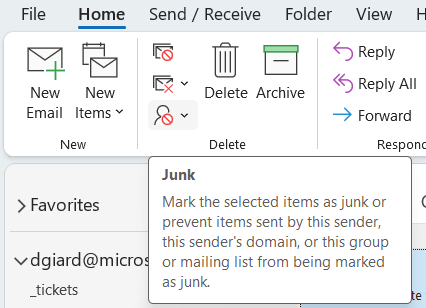
Open Microsoft Outlook. On the "Home" ribbon, you will find the "Junk" button, as shown in Fig. 1.

Junk Button
Fig. 1

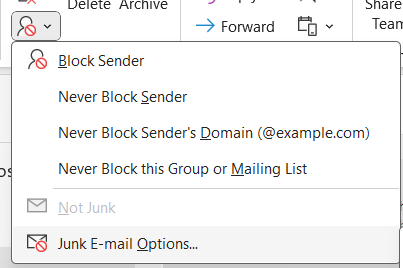
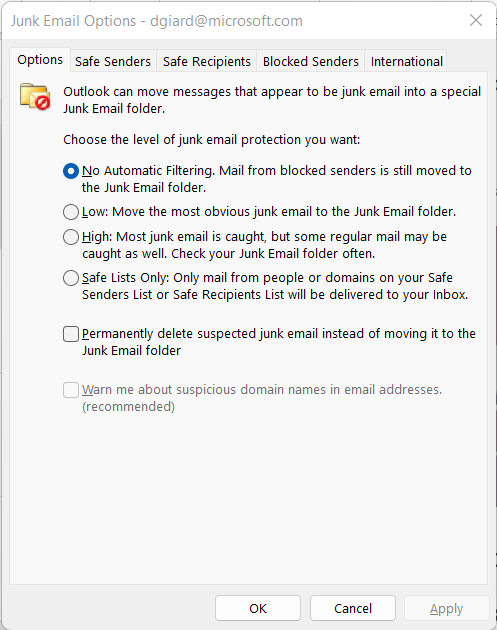
Click "Junk" button to expand the menu, as shown in Fig. 2 and select "Junk E-mail Options" to open the "Junk Email Options" dialog, as shown in Fig. 3.

Junk Mail Menu
Fig. 2

Junk Email Options Dialog
Fig. 3

The "Options" tab allows you to set how aggressive you want Outlook to be about identifying junk mail. Setting this to "Low" or "High" tells Outlook to use Machine Learning to identify junk mail. Outlook's algorithm ML will sometimes make mistakes. Setting it to "Low" may miss some junk mail. Stetting it to "High" may identify some legitimate mail as "Junk."

"No Automatic Filtering" and "Safe Lists" only options do not use Machine Learning. Rather, explicit rules determine where mail should go.

By default, Outlook moves junk mail into the "Junk email" folder, giving you the opportunity to review these items before deciding whether to delete them. But, you can opt to automatically delete any email identified as junk by checking the "Permanently delete suspected junk email" checkbox.

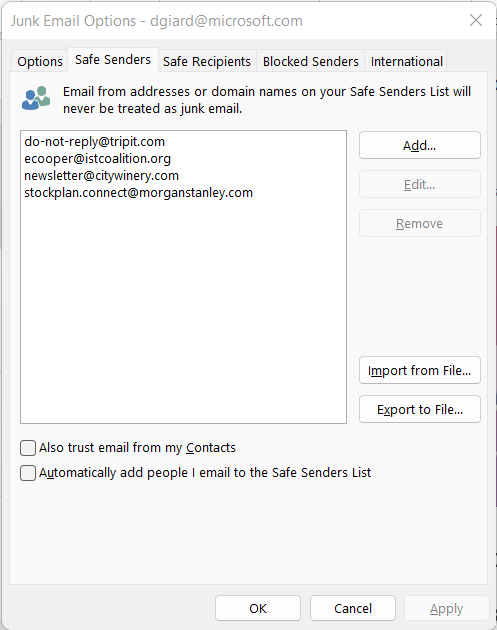
The "Safe Senders" tab (Fig. 4) allows you to add email addresses of people you trust.

Safe Senders Tab
Fig. 4

Emails received from these senders will not be considered junk mail, even if they contain a body or header that Outlook would otherwise identify them as junk.

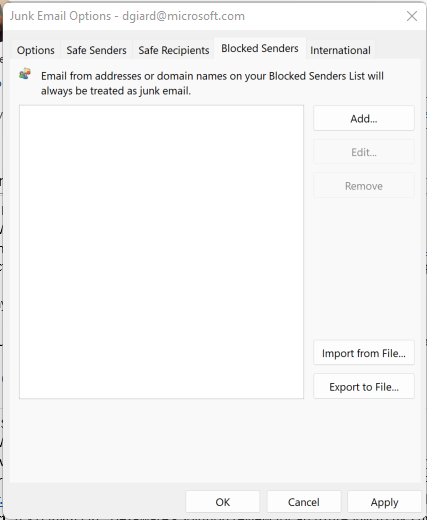
The "Blocked Senders" tab (Fig. 5) is just the opposite of Safe Senders.

Blocked Senders Tab
Fig. 5

Emails received from these senders will always be considered junk mail, even if they contain a body or header that Outlook would otherwise identify them as not junk.

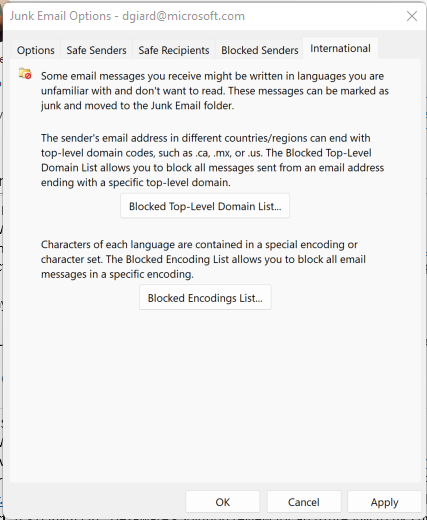
The "International" tab (Fig. 6) allows you to block emails from a top-level domain or containing specified character sets.

International Tab
Fig. 6

For example, if I am plagued with bogus email from Russia and I feel confident I will never receive any legitimate email from Russia, I can block all emails with with an address ending in ".ru".

Additionally, if I often get spam emails written in a Japanese character set and I do not know anyone who writes Japanese, I can choose to block all emails that contain the Japanese character set encoding.

How you configure your junk email settings is up to you and your comfort level. This article shows how to configure Junk Mail settings in Microsoft Outlook.


GCast 158:

Azure Application Insights Alerts

Learn about Azure Application Insights Alerts and how to create and manage them.


Episode 766

Mike Richter on Taking AI Apps to Production on Azure

Partner Solution Architect Mike Richter discusses deploying an AI application to production in Microsoft Azure.


The cast of The Innocence of SeductionLast year, I saw and loved Mark Pracht's "The Mark of Kane" at City Lit Theater in Lakeview. That play told the story of Bob Kane and Bill Finger's creation of the iconic Batman character and Kane's work to take all the credit. I enjoyed it enough that I did not hesitate when City Lit announced Pracht's play "The Innocence of Seduction" - the second in his promised "Four-Color Trilogy," which focuses on the history of comic books.

"Innocence" tells of the censorship of comic books in the 1950s, when US government officials were actively destroying careers and lives in the name of patriotism and decency. The play takes its title from Dr. Fredric Wertham's 1954 book "Seduction of the Innocence," which blamed juvenile delinquency on the comic book industry. According to Wertham, reading comic books caused children to become violent, rebellious, and amoral. Congress took note and turned public sentiment against comic book publishers. The issue resulted in establishing The Comics Code Authority (CCA), which approved only comics that met an arbitrary level of "decency." Because no distributors would accept comics without the code's seal, this meant the end of crime comics and horror comics. The move particularly affected William Gaines and EC Comics, which pioneered titles such as "Tales from the Crypt" and "Crime SuspenStories."

This play focuses on the rise and fall of EC and Gaines's struggle against the CCA and its demagogue leader, Judge Charles Murphy. Other real-life characters appear, such as gay, black artist Matt Baker (played by Brian Bradford) and female artist Janice Valleau (played by Megan Clarke); but it is Sean Harklerode as Gaines who steals the show. The neurotic and passionate publisher dominates every scene in which he appears. All these characters were real people affected by the events of their times. This production gave depth to those characters.

A creepy Wertham wandered in and out of scenes, casting judgment on the comic medium. Often, visuals from comic books appeared on an oversized television at the back of the set.

With 15 cast members and 22 characters, this is the largest production I have seen at City Lit. The cast nearly outnumbered the audience, which only numbered about 25 for this preview performance - small, even for this tiny theater on the second floor of a church. However, the sparse turnout did not dampen the performers' enthusiasm or the production's quality.

"The Innocence of Seduction" is filled with humor and tragedy. It deserves a larger audience.


Miles Roby grew up in Empire Falls, Maine. He has seen the place transition from a thriving textile and lumber center to a city trapped in economic despair. The factories closed years ago, and those who remain have false hope that the industries, employment, and prosperous economy will return. Miles's mother hoped he would escape when she sent him away to college, but he dropped out and returned to care for her in the weeks before she died. That was long ago, and Miles is still here.

Richard Russo's 2001 novel "Empire Falls" is mostly Miles's story. But it is also the story of a city weathered by adversity and of the people who remained.

The title refers to the location where most of the story takes place, but it may also refer to the fall of an empire. The city itself is a fallen empire, and so is its founding family - The Whitings. Dowager Francine Whiting is currently the family matriarch who still holds much of the town's depressed property. She owns almost everything in the city, which leads her to assume that she also owns its residents. Francine is one of the story's villains - manipulating those around her and making life difficult for Miles.

The town has many dark secrets. Terrible fathers raise sons who grow up to be terrible fathers and husbands, abusing their wives and instilling poor values in their children, perpetuating a cycle that has continued for generations.

Miles attempts to break this cycle, despite being surrounded by mediocrity. His father is an unkempt slacker whose greatest talent is getting others to pay for his drinks and his annual trip to Key West. Miles's wife Janine has left him and plans to marry arrogant, dishonest Walt Comeau, primarily because sex with Walt is so much better than with Miles. Miles's daughter Tick is artistic and has a good heart but suffers from the angst of trying to fit in with the popular kids at her high school - particularly her ex-boyfriend Zack Minty. Zack is a star football player and a bully who reserves his worst torments for Tick's extremely introverted friend John Voss. Zack's father, Jimmy, is Miles's other antagonist. Jimmy - Miles's former high school classmate - is currently a policeman, lacking in wit and integrity. He insists that he and Miles were once friends, but Miles wants nothing to do with him. Miles perseveres, trying his best to lead a decent life.

The book introduces a lot of characters and a lot of character backstories. But this is necessary because these characters drive the story more than the plot.

The plot tends to move slowly until an unexpectedly violent climax at the end.

Russo fills in gaps with decades-old flashbacks, revealing the history of the families and the town and answering questions raised previously. Francine's husband, Charles Whiting, rejected the ruthlessness of his family's business practices and considered escaping from a loveless marriage; but he was too weak to succeed at either. He temporarily fled to Mexico before returning to Empire Falls and taking his own life.

"Empire Falls" raises questions about how much control we have over our lives. Do we accept the fate handed to us, or do we work to forge our own path? Miles is different from most of his narrow-minded neighbors; but he suffers from the same frailty - he lacks the courage to leave a dying town and begin his life again. It is not until the violent incident at the end that he begins to examine his life options.

This book paints an unflattering picture of American backwaters. But Russo tells the story well, and it resonated with me.


Leigh Bardugo's "Crooked Kingdom" concludes the story begun in "Six of Crows," which expands on the universe she created in her "Shadow and Bone" trilogy.

"Six" ended on a cliffhanger. After Kaz Brekker and his crew broke a scientist out of a maximum security prison, evil gazillionaire Jan Van Eck reneged on his deal. Van Eck kidnaps Inja to coerce Kaz into delivering the scientist with the secret to the formula to control the mystical Grisha. Kaz sets out to rescue Inja with his remaining crew - a band of misfits, each possessing a unique talent. He also seeks revenge against those who have wronged him.

It sounds complicated because it is. Kaz is a brilliant strategist, but Van Eck keeps thwarting his well-laid plans, forcing Kez to adjust his plans, which causes Kaz to respond, and so on. It is a fun game of cat-and-mouse with many twists and turns.

I do not recommend reading this book except as a part of the duology. Bardugo introduces her characters with little explanation of who they are.

This is the strongest of the five books I have read in this series. Bardugo does an excellent job building a plot with multiple twists and turns. She keeps us guessing as the heroes and villains play a game of mental leapfrog. She creates the characters and the relationships between them, making the reader care about each of them. One by one, Bardugo tells the backstory of each main character introduced in "Six of Crows," revealing their motivation and providing a satisfying depth to each of them.

As a bonus, a few characters from the original trilogy also make an appearance.

"Crooked Kingdom" contains multiple adventures, multiple love stories, and multiple action sequences. It includes joy and danger and a single great tragedy. It is smart, and it is fun! It is a solid finish to this duology.

Transactable Containers Videos

Comments [0]

Episode 765

Juan Llovet de Casso on Microsoft Fabric

Architect Juan Llove de Casso discusses Microsoft Fabric a unified solution that allows enterprises to perform analytics using multiple tools and multiple sources of data.

Links:

https://learn.microsoft.com/fabric


August 2023 Gratitudes

Comments [0]

8/7
Today I am grateful to see the new Mission Impossible movie in a theater this weekend.

8/8
Today I am grateful that I almost always wake up before my alarm.

8/9
Today I am grateful for smart people who are willing to share their knowledge.

8/10
Today I am grateful I was finally able to renew my password manager subscription.

8/11
Today I am grateful for:
- an excellent concert last night featuring Lenny White, Buster Williams, and Cyrus Chestnut
- seeing the Immersive Mozart multimedia show

8/12
Today I am grateful to catch up with Kevin yesterday.

8/13
Today I am grateful for:
- an excellent concert at Jazz Showcase last night featuring the Charles McPherson Quartet
- a visit to the Printers Row Art Fair yesterday afternoon

8/14
Today I am grateful to finally sort through all those papers and mail on top of my kitchen table.

8/15
Today I am grateful for the corned beef at Manny's Deli

8/16
Today I am grateful to sip Drambuie at home on a quiet evening

8/17
Today I am grateful to see the "Art on the Mart" multimedia show last night outside the Merchandise Mart.

8/18
Today I am grateful for:
- Lunch with Barbara and Jack in San Juan Capistrano yesterday
- Seeing my first game at Petco Park with Scott last night

8/19
Today I am grateful for:
- Lunch with Tim in Carlsbad yesterday
- An exciting baseball game on my first visit to Angels Stadium last night

8/20
Today I am grateful for
- an afternoon with Madeleine in Beverly Grove
- my first visit to Dodger Stadium

8/21
Today I am grateful for:
- a visit to Disneyland with my son yesterday
- beers with Hattan last night

8/22
Today I am grateful for
- Breakfast with Andy yesterday
- a short vacation in southern California

8/23
Today I am grateful to see Goo Goo Dolls and A.O.R. in concert last night.

8/24
Today I am grateful to volunteer for the ChooseU Breaking Barriers program yesterday.

8/25
Today I am grateful to catch up with Esteban yesterday.

8/26
Today I am grateful I was able to repair my broken kitchen faucet yesterday.

8/27
Today I am grateful to attend the Thalia Hall Block Party yesterday in Pilsen

8/28
Today I am grateful to go kayaking on the Chicago River yesterday.

8/29
Today I am grateful my team has expanded to include all of North and South America, allowing me to work with more people from other countries.

8/30
Today I am grateful to Randy for coming to downtown Chicago yesterday and buying me dinner.

8/31
Today I am grateful to talk with Barry this morning for the first time in years.

9/1
Today I am grateful to take my son and his fiancé out to an excellent French restaurant last night to celebrate his birthday.

9/2
Today I am grateful:
- to see Don McLean in concert last night in St. Charles
- to talk with Jose yesterday for the first time in years

9/3
Today I am grateful to have Maisie and Zoe stay with me this weekend.


Don McLean1Don McLean has always loved early rock and roll. He showed this love Friday night at the Arcada Theatre in St. Charles. He showed it by performing the music of Elvis Presley, Roy Orbison, and Johnny Cash. He showed it by writing songs like the rockabilly bouncer "American Boys Invented Rock N' Roll." And he showed it in the lyrics of his biggest hit, "American Pie," which lamented the death of Buddy Holly, Ritchie Valens, and the Big Bopper and delivered a commentary on the music and musicians of the 1950s and 1960s.

This tour celebrated the fiftieth anniversary of the release of "American Pie" - the album and the single. McLean's set included only three songs from that album. He sang the haunting "Crossroads," accompanied only by the beautiful piano playing of Tony Migliore. He played my personal favourite, "Vincent," which I count among the most beautiful songs ever written. He closed the set with an extended rendition of "American Pie" and had no trouble encouraging the audience to sing along.

The concert was not long - less than 90 minutes - but it was entertaining. McLean sang and played guitar like he still enjoys it. He noted that some performers do not like to play their hits. "They should not be in show business," he insisted as he played his hits.

In between songs, McLean told stories and engaged the audience with self-deprecation. He admitted he could not hit the high notes when performing The Skyliners' "Since I Don't Have You," but he was not far off the peak range of his younger days. At 77, he still sounds great and still enjoys touring.

The evening contained a mix of originals and covers. We enjoyed a rousing version of Cash's "Folsom Prison Blues," a mournful rendition of Orbison's "Crying," and a rocking performance of Presley's "Little Sister."

I was 11 years old when someone in my family bought a 45RPM record of "American Pie." The song was so long it had to be split between the two sides. I memorized all the words, and we sang them on our car trips. In college, I bought a vinyl copy of the "American Pie" LP and played it until it wore out. But I had never seen Don McLean perform live until tonight. It took fifty years, and it was worth the wait.


Natasha Trethewey's "Native Guard" tells dark stories through beautiful poetry.

The title poem tells the story of a black soldier during the Civil War. His battalion - one of the first to include black Americans - was charged with guarding white Confederate prisoners. These were men who previously owned or would have owned black men.

"We know it is our duty now to keep
white men as prisoners - rebel soldiers,
would-be masters. We're all bondsmen here, each
to the other. Freedom has gotten them
captivity. For us a conscription
we have chosen - jailors to those who still
would have us as slaves. They are cautious, dreading
the sight of us."

Trethewey includes other poems about the history of the South, which she views with mixed emotions. She grew up in Mississippi and Atlanta, but her family was ostracized because her parents were of different races.

She includes poems about her own family - in particular about the death of her mother, who was murdered by her second husband when Natasha was a teenager.

The collection is a chronicle of what it is like to be black in the American South. Despite being a white man in Chicago, every poem resonated with me.


GCast 157:

Using the Application Insights .NET SDK

Learn how to write .NET code to interact with Azure Application Insights.


Overview

Developer Velocity (DV) is a broad term that describes how we can increase efficiency for developers building software solutions. It involves using the right tools to write software, implementing automated processes for continuous integration and deployment, properly monitoring our software, providing feedback loops, and any method or tool that removes friction for the development team.

Increasing Developer Velocity means reducing the time to write, debug, test, deploy, and update software. Developer Velocity tends to increase as developers become more agile and innovative.

The term is a bit misleading, as "Developer Velocity" success depends on many people in the organization besides developers. Everyone in the development process can contribute to Developer Velocity.

Many factors go into increasing DV. Hiring and retaining high-quality people, using the right tools, and fostering the right team culture are just a few factors. When we consider each of these, we need to focus on removing barriers, allowing the team to focus on moving forward without getting bogged down by needless friction.

Tools

McKinsey describes an "Inner Loop" (activities that directly build and test software) and an "Outer Loop" (supporting activities and non-functional requirements, such as security, deployments, and integrating with other systems). We should seek to automate as much of the outer loop as possible and focus our time and mental activities on the inner loop. The human brain works best on inner loop tasks, but we can use tooling to assist us with this process.

Using Generative AI tools can significantly increase velocity. A study by McKinsey revealed a velocity increase of up to 45%, depending on the complexity of the code involved. GitHub Copilot, GitHub Copilot Chat (currently in preview), and ChatGPT can generate code from human language descriptions. That code is not always perfect, but it is a starting point.

Other AI tools, such as Cognitive Services and OpenAI may allow your applications to take advantage of Artificial Intelligence without the time and effort required to build your own models.

Deploying to a public cloud platform eliminates the need to purchase and maintain an internal data center.

Low-Code/No-Code tools such as Microsoft Power Platform can reduce the time it takes to develop forms, workflows, and other software services and applications.

Azure DevOps, GitHub, and other Application Lifecycle Management (ALM) tools allow you to automate running tests, integrate updates into the existing software system, and deploy code. Automation makes these tasks more repeatable and requires less manual intervention, which tends to reduce errors. An automated Continuous Integration / Continuous Deployment (CI/CD) system is invaluable in maintaining velocity.

Implementing feature flags can save customization time because it allows users and administrators to turn features on and off through configuration without writing custom code.

When onboarding a new developer, it takes time to set up a new computer. Tools like Visual Studio Codespaces and Microsoft Dev Box can reduce that time.

Consider incorporating Open Source Software (OSS) into your applications rather than writing your own components. Many OSS projects exist that may exactly meet your needs and can save you the time of developing them yourself. Many users have already tested popular OSS projects. These projects have the added advantage that contributors add new features and bug fixes, of which you can take advantage.

Testing

Automated testing can catch many problems earlier in a product's development lifecycle. The Shift-left approach states that issues are less expensive to resolve the sooner they are discovered. Important types of testing are:

  • Unit testing
  • Integration Testing
  • Acceptance Testing
  • Performance Testing
  • Chaos Testing

Security

Building security into every step of your development process saves time in the long run. Adding security at the end without planning can be expensive, time-consuming, and ineffective. Static Application Security Tests (SAST) involves reviewing the source code for security vulnerabilities. Dynamic Application Security Tests (DAST) involves testing the application externally for security flaws. Automated scanning of source control repositories can detect secrets, such as passwords or connection strings erroneously checked into the repository.

Feedback and Monitoring

A fundamental premise of many agile methodologies is fast feedback. Reducing the time to receive feedback from users and acting on that feedback also increases Developer Velocity.

Feedback can come from users, or you can acquire it via application monitoring and alerting. A comprehensive monitoring strategy will let you know when errors occur or when problems are imminent. Using Azure Monitor and Application Insights, you can configure alerts that notify you when a system's behavior or performance falls outside an acceptable range.

For more information, see the articles and videos I created covering Azure Monitoring.

People and Culture

Team culture can have a significant impact on velocity.

In their article Developer Velocity: How Software Excellence Fuels Business Performance, McKinsey reports "Organizations that enable software teams to experiment, fail, and learn in a safe environment see consistently better results."

Creating a culture like this encourages innovation and helps to retain top workers. Your chances of improving velocity increase with better people.

Using modern tools, as described above, also helps your organization retain talent, as most talented developers would rather spend their time building functional software than maintaining system "plumbing." Providing developers with the right tools not only increases their productivity but can also increase their job satisfaction, leading to longer retention.

Measuring Velocity

McKinsey created the Developer Velocity Index to measure this velocity at the system, team, and individual levels. DORA Metrics, created by the Google Cloud's DevOps Research and Assessment team, can also manage the efficiencies of the software creation process. These metrics can help you understand your goals and where to improve. Regardless of how you approach or measure your velocity, it is crucial to identify the bottlenecks in your development process and seek ways to improve them.

When getting started, Microsoft provides a DV Assessment, which takes about 20 minutes to complete and asks about your organization's architecture, engineering practices, and tooling. Based on your responses, this tool returns a set of scores by category and a set of recommendations.

Conclusion

Developer Velocity is all about rolling out high-quality features and fixes to your users as quickly as possible. Achieving this goal takes a combination of people, tools, and processes; but it leads to higher business performance.

Microsoft Tools

Here are some useful tools from Microsoft:


Downloading Facebook Data

Comments [0]

I have posted information to Facebook for years. I do not know what the law says on the topic, but I believe all that information belongs to me.

I may wish to download my data in order to transfer it to another platform, to search through a subset of the information more easily, or to preserve it before deleting my account. 

Each month, I download all my Facebook posts to easily find my daily gratitude posts, which I post here on the first Sunday of each month.

Facebook allows me to download any or all that information to my local computer, but it is not obvious how to do this.

Here are the steps to download your information from Facebook.

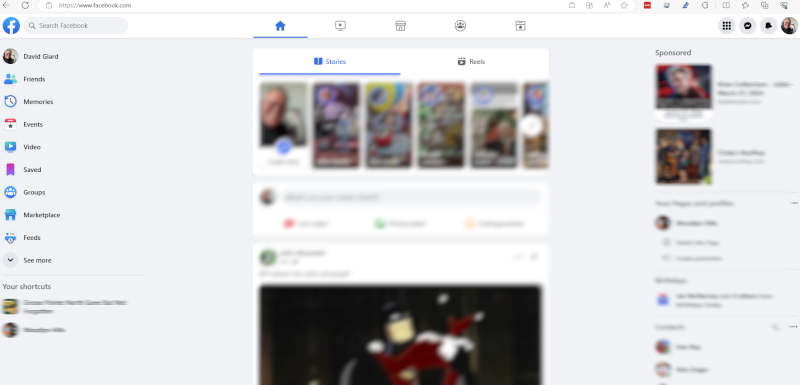
Log into your Facebook account, as shown in Fig. 1

Facebook Home

Fig. 1

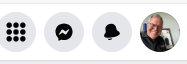
From the buttons at the top-right of the page (Fig. 2), click the [Account] button. This will probably have either your profile photo or your initials. 

Top Right Buttons

Fig. 2

Clicking the [Account] button expands the "Account" menu, as shown in Fig. 3.

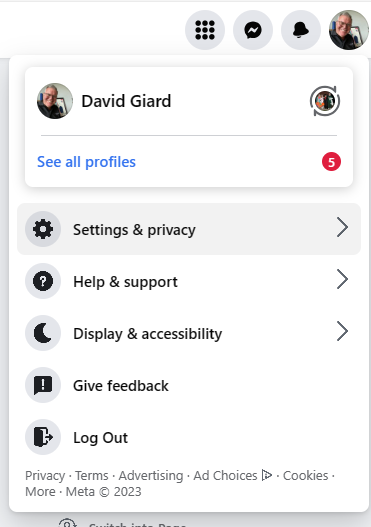
Account Menu

Fig. 3

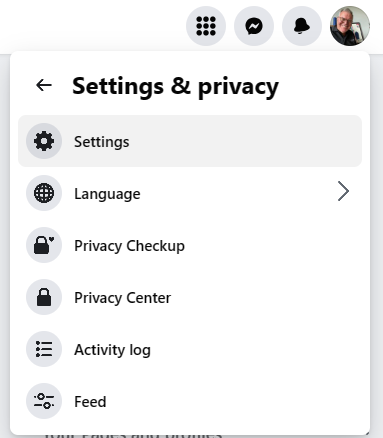
From the "Account" menu, select "Settings & privacy" to display the "Settings & privacy" menu, as shown in Fig. 4.

Settings And Privacy Menu

Fig. 4

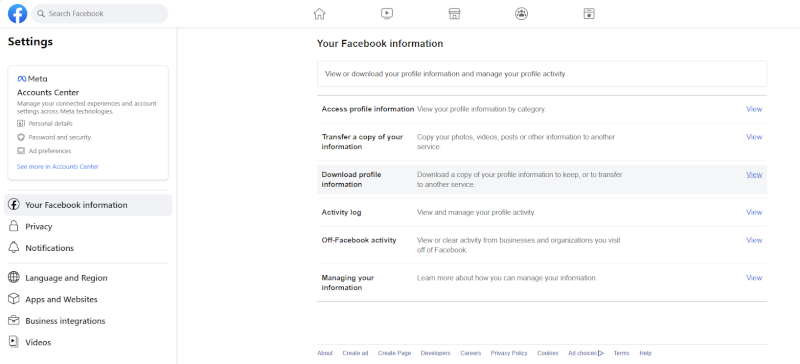
From the "Settings & privacy" menu, select "Settings" to display the "Settings" page, as shown in Fig. 5.

Settings Page

Fig. 5

At the "Settings" page, click [Download profile information] (Fig. 6) to display the "Downloads" page, as shown in Fig. 7

Download Profile Information Link

Fig. 6

Downloads Page

Fig. 7

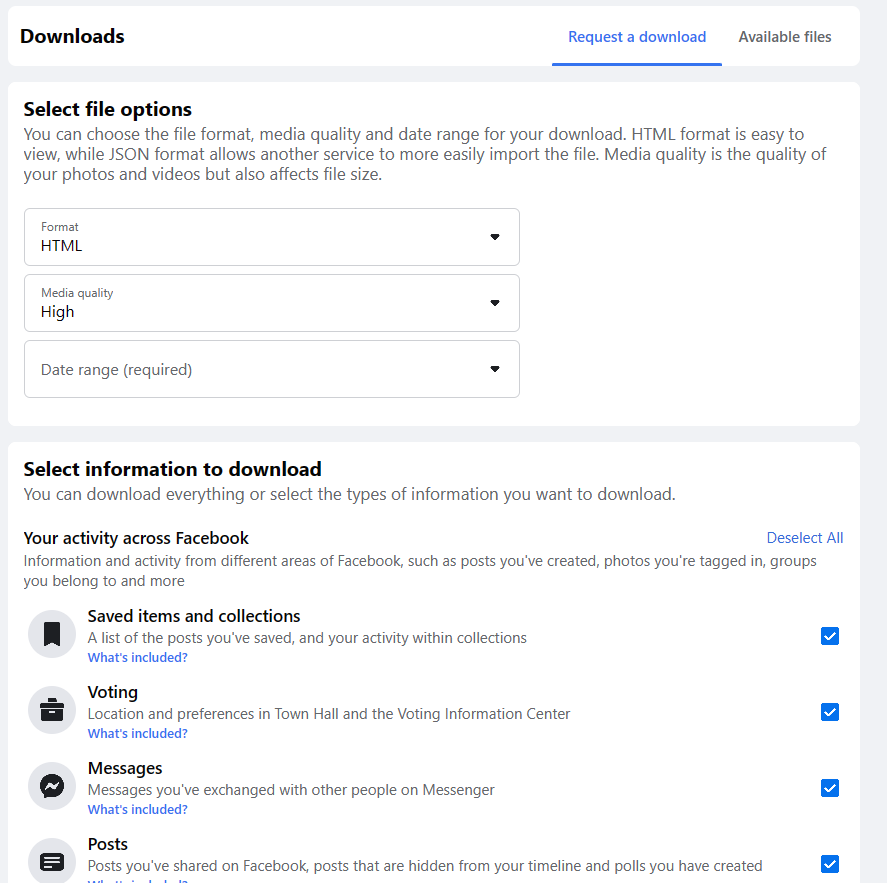
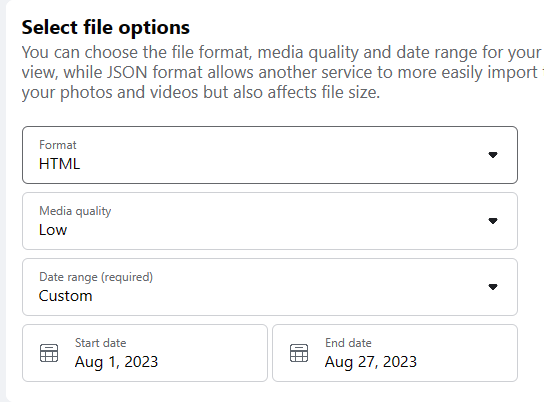
Fig. 8 shows the options you may specify for the file you download. You can select the Format, media quality, and date range.

Select File Options

Fig. 8

At the "Format" dropdown, select the format in which you want to receive your data. The options are "HTML" and "JSON".

At the "Media quality", select the quality ("High", "Medium", or "Low") of the images, videos, and audio files you download. Of course, high-quality images are much larger than low-quality images.

At the "Date range" dropdown, select the range of data you wish to download. The dropdown offers a few built-in suggestions, such as "All time", "Last week" and "Last year", but you can select "Custom" and enter your own date range.

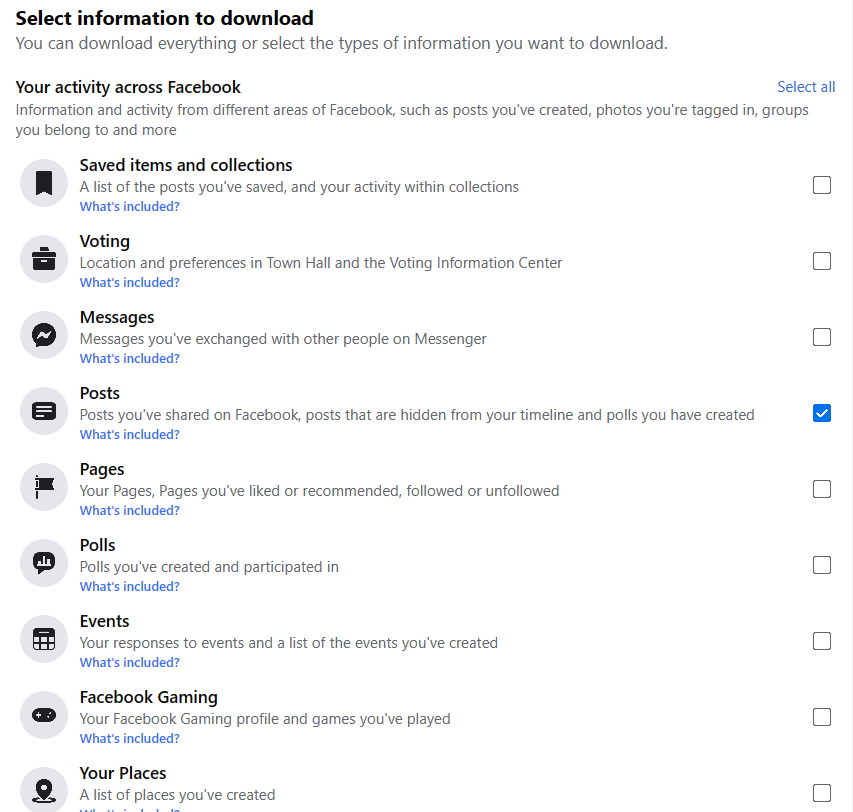
Fig. 9 shows the options to select which information you want to download. 

Select Information To Download

Fig. 9

Anything you check will be included in your download (and will increase the file size). You can individually check and uncheck boxes or toggle them all by clicking the "Select all" or "Unselect all" link. For my monthly download, I only want to view posts, so I click "Unselect all"; then check the "Posts" checkbox.

When you have finished entering all your criteria click the [Request a download] button (Fig. 10) at the bottom of the "Downloads" page.

Request A Download Button

Fig. 10

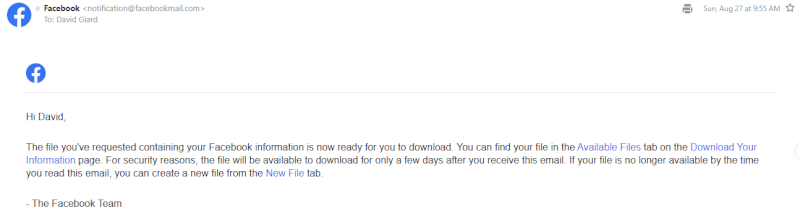
The download does not happen instantly. You will quickly receive a message indicating that someone requested a download of your Facebook information. When Facebook has finished processing your data, you will receive another email, like the one shown in Fig. 11, indicating that your downloaded data is ready.

File Ready Email

Fig. 11

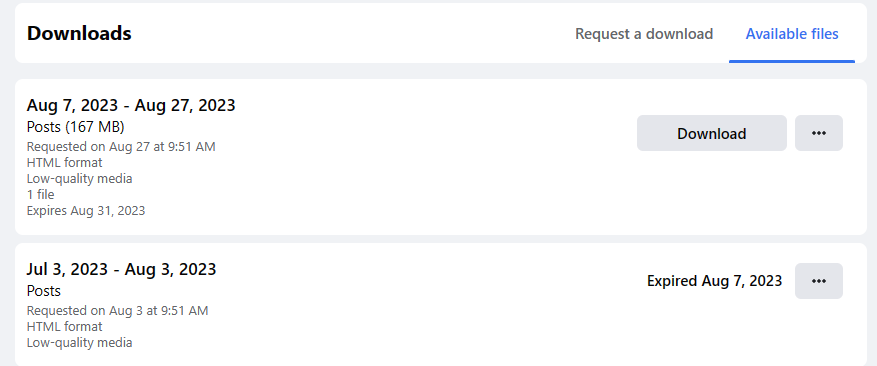
Click the "Available Files" link in this email to open a browser with the "Available files" tab of the "Downloads" page displayed, as shown in Fig. 12.

Available Files Tab

Fig. 12

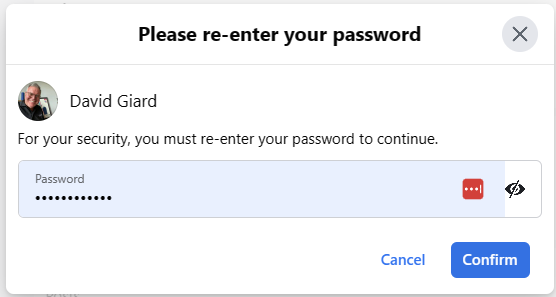
The files are listed in descending order by date created, so the file you recently requested should be at the top. Click the [Download] button next to your file. You will be prompted to enter your Facebook password (even if you are already logged in), as shown in Fig. 13. This is an extra security measure in case someone accesses your email. 

Re-Enter Password Dialog

Fig. 13

Enter your password and click the [Confirm] button.

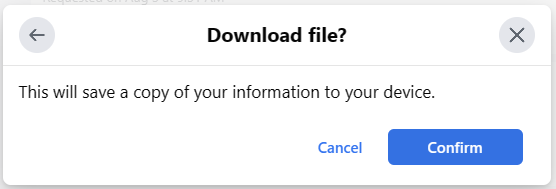
The "Download file" confirmation prompt displays, as shown in Fig. 14.

Download File Confirmation

Fig. 14

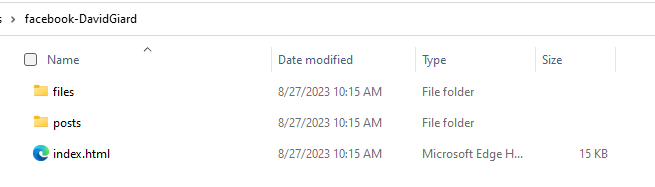
Click the [Confirm] button to begin downloading your file. This will download a ZIP file containing the information you requested. Extract this file to a new location. Fig. 15 shows the extracted HTML files.

Downloaded Extracted Files

Fig. 15

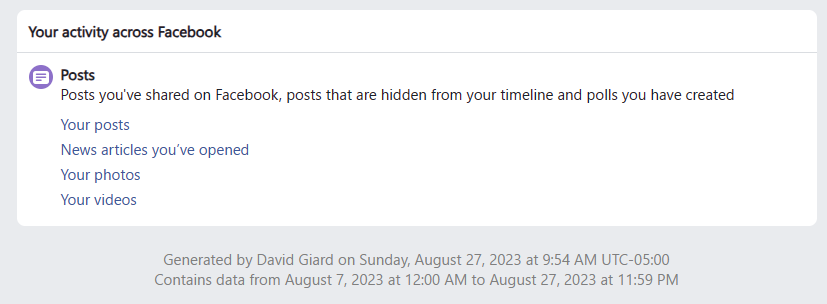
For an HTML download, you can open index.html in a web browser and navigate it, as you would the Facebook web page. For a JSON file, you may wish to interact with it programmatically or import it into another service or application.

Fig. 16 shows the Index.html file rendered in a browser.

Index In Browser

Fig. 16

In this article, I showed you how to request a download of your Facebook data.


Episode 764

J. Tower on Migrating Legacy ASP.NET Applications

J Tower discusses some of the tools and methods used to migrate ASP.NET applications to .NET Core, including the Visual Studio Upgrade Assistant and YARP (aka "Yet Another Reverse Proxy").

Links:

https://microsoft.github.io/reverse-proxy/

https://microsoft.github.io/reverse-proxy/articles/getting-started.html

https://learn.microsoft.com/en-us/dotnet/core/porting/upgrade-assistant-overview


Louise Erdrich's 2002 novel "The Night Watchman" explores life among the Chippewa Indians on the Turtle Mountain Reservation in northern North Dakota in the 1950s.

The story follows the lives of many people living on the reservation.

Patrice is an intelligent, attractive teenage Chippewa girl. Her alcoholic father is mostly absent, and her sister Velma is missing after moving to the Twin Cities and giving birth to a son.

Thomas Wazhask is The Night Watchman of the story's title. He serves as the tribal leader during the day and holds a night job at a local factory. His lack of sleep causes him to hallucinate. Some of his hallucinations appear prophetic - visions of the lost Velma and conversations with Roderick, a boy who died when disciplined while they were at boarding school years earlier.

At the time of the story, Senator Arthur V. Watkins introduces House Concurrent Resolution 108 bill, which proposes to force Native Americans off the reservation and strip them of their ability to govern themselves. If enacted, this resolution would break every treaty made with every tribe in the United States.

Patrice sets out to find her missing sister while Thomas organizes a defense against the Congressional Bill.

The story concerns the lives and trials of those on the reservation. The point of view shifts between the characters, and we learn of their loves and jobs and their struggles with money, and their relationships - all the things that make them real in the readers' eyes. This realness makes the cold logic of Watkins all the more harsh.

Erdrich slowly uncovers layers of the story by recalling past events, then revealing details of those events later. She never reveals some things, such as whether the ghost or Chippewa magic or Thomas's visions are real.

Erdrich does an excellent job of bringing these characters to life and forcing the reader to feel for them, even if we have no experience living as second-class citizens or living in poverty, or fighting the might of the US Government. She incorporates the impending threat of the Termination as a way of disrupting the lives of the tribespeople.

The author based the novel on actual events. Thomas is a fictionalized version of the author's grandfather, and she patterned many of the characters after his contemporaries. The Congressional Resolution was real, as was Senator Watkins.

"The Night Watchman" is a coming-of-age story that explores family, gender, poverty, sex, and how governments affected the lives of Native Americans. It contrasts life on a reservation, where the people strive to maintain their traditional ways, with the coldness of the cities, where their tradition stands no chance.


Joshua Cohen wrote his 2021 novel "The Netanyahus" after a conversation with literary critic and university professor Harold Bloom. Bloom told Cohen of the time he interviewed Benzion Netanyahu for a professorship at Cornell. Cohen took the story, filled in some gaps with his imagination, replaced Bloom's with a fictional character named "Ruben Blum," replaced Cornell with the fictional Corbin College, and the rest is history. Or at least historical fiction.

The Netanyahu of the novel is loud and arrogant and condescending and rude and demands respect. But he is also thoughtful and intelligent when lecturing to an audience or describing his philosophy. He arrives at the Blum home with his wife and three children, and the five of them bring chaos with which the unassuming Blum cannot deal.

The book is more about Blum, who is awkward and trying to establish his life and academic career. His daughter and wife resent him; his parents and in-laws criticize everything from his home decor to his decision to move out of New York; and the faculty at Corbin College patronizes him with microaggressions as the only Jewish person on staff.

Cohen's writings are reminiscent of Vladimir Nabokov and Philip Roth. Like Nabokov, he places his characters in absurd situations and portrays dark humor in their attempts to navigate those situations. Cohen's characters echo Roth's, as his Jewish immigrants alternately assimilate into American society and loudly retain their European heritage. In one scene, Blum's mother-in-law chastises Blum while her husband struggles loudly with his gastrointestinal issues behind a bathroom door. This scene could have been written by Roth.

Cohen tells his story with humor and intelligence. I do not know how much is true, but I know that I enjoyed it.


California Dreaming 2023

Comments [0]

IMG_3980Disneyland in the rain, rescheduled baseball games, a Pacific hurricane, friends and family, and a wedding I did not attend. That was my California trip.

In my quest to attend a home game at the current stadium of every Major League team, I had long planned to visit southern California during a week when the Padres, Angels, and Dodgers were at home. I chose this past weekend because of the teams' schedules and because I could travel with my son Nick, who was attending a wedding in Anaheim.

I planned to see the San Diego Padres on Thursday, the LA Dodgers on Saturday, and the LA Angels on Sunday. The weather had other plans.

Day 1

IMG_3990Waking up at 3:30 AM is challenging but necessary to catch a 7 AM flight. After landing at John Wayne Airport in Orange County and picking up my luggage and rental car, I drove south to Laguna Hills to visit my cousin Barbara and her husband, Jack. The three of us ate lunch at El Adobe - a delicious Mexican restaurant in San Juan Capistrano that was a favourite of former President Richard Nixon. It was the same place I met Barbara when my son Tim and I visited in 2017.

After lunch, I drove down to San Diego, where I checked into a hotel in a building built as a bank almost 100 years ago. One can still see the vaults in the basement.

I met Scott at a downtown bar, and we attended a Padres - Diamondbacks game at Petco Park. It was my first visit to Petco and my first time seeing Scott in person in years. He hired me at Microsoft 10 years ago, then took a new role and moved to the West Coast a year later. I had almost no contact until he hired me again to his team last year.

Day 2

IMG_4013I drove up to Carlsbad Friday morning and met my friend Tim for lunch at (another) Mexican restaurant. We spent a leisurely time catching up and talking about his new role as CTO of an AI startup.

Nick's plan was scheduled to land at 8 PM Friday, so I drove to our hotel in Anaheim, expecting to relax for a few hours before picking him up at the airport. The weather altered my plans.

IMG_4029Hurricane Hilary hit the west coast of Mexico and began to move up the coast. Predictions called for a hurricane or severe tropical storm to strike the Los Angeles area on Saturday and Sunday. Locals expected the worst storm in a century. In anticipation of the tempest, the Angels moved their Sunday game to Saturday afternoon, which disrupted my schedule. I had promised Nick I would take him to the baseball game on Sunday. Now, there was no Sunday game, and the wedding conflicted with Saturday's game, so he could not attend. I decided to go to Angels Stadium Friday evening instead. I had to leave at the top of the seventh inning to drive to the airport. I witnessed a second-inning grand slam by Shohei Ohtani, but I missed the Angels turning a triple play in the bottom of the ninth. The Tampa Bay Rays won in 10 innings.

Day 3

iIMG_4065Saturday, Nick and I ate breakfast together before going our separate ways. He was invited to the afternoon wedding of his high school friend, while I had promised to help my friend's daughter. Madeleine recently moved to Los Angeles, and I offered to take her to lunch. She asked me to help change the battery in her car's key fob while I was here. It turned out to be more complicated than that. After driving to buy a new battery, we discovered the problem was a dead car battery, not the key fob. Neither her car nor my rental car had jumper cables, so we had to leave again to buy a pair. I was able to jump-start the vehicle, and we went to dinner at a nearby restaurant. When we returned, the car would not start again. So, I jumped it again and asked her to run it for 20 minutes before turning it off, then try again in the morning. This worked, and the car is now in good shape.

Sadly, the delay cost me so much time that I did not arrive at Dodgers Stadium until the bottom of the sixth inning. The Dodgers defeated the Marlin - the only home team victory I witnessed this week - and I left my seat less than an hour after arriving. Traffic flow at this stadium is so bad that it took me twice as long to exit the parking lot as I spent watching the game. With the needle approaching "E," I worried I would run out of gas in the middle of the exit lane.

Day 4

IMG_4071The bad weather and the canceled game disrupted our schedule, so Nick and I wondered what to do all day Sunday. The other wedding guests departed in the morning, so Nick and I visited Disneyland. It was Nick's first time at the park and my first visit since I was four. The constant rain diminished the experience, but the poor weather also discouraged others from attending, which minimized crowds and wait times on rides. We spent over five hours at the park. Some highlights were Rise of the Resistance, Smugglers Run, Indiana Jones, and Pirates of the Caribbean.

In the evening, we met my friend Hattan at a local brewery to sample different beers before heading to the hotel and falling asleep almost instantly.

Day 5

IMG_4103I arranged to meet my co-worker Andy for breakfast on Monday. Andy and I have worked together for over a year but never met in person, so it was a treat.

The dire weather predictions turned out to be incorrect. Monday was a beautiful day with sunshine and a few fluffy clouds - precisely what one pictures when envisioning the southern California climate. Nick and I wandered through a quaint neighborhood in Orange, CA. From the many cafes, we chose a Thai restaurant located off an alleyway near the center of town. After lunch, we walked around Chapman University - a small but pretty campus a few blocks away. Nick is a regular listener to a podcast hosted by one of the Chapman assistant basketball coaches. We walked around the gym, but no one seemed to be working that day.

Our flight home was thankfully uneventful. The best part was that the flight attendant allowed Nick to move up from his discounted seat to an empty row in Economy Plus to sit next to me.

Final Thoughts

I returned to work Tuesday morning. I have renewed energy from a few days off but still have jet lag and sleep debt. The trip was a great success. I visited some friends and family I had not seen for a long time; I made a rare visit to Disneyland; I made significant progress on my baseball stadium bucket list (only two stadiums remain); and I spent quality time with my son.

I was fortunate that the weather cooperated, that friends were available to meet, and that I could adjust my schedule to changing situations. I packed a lot into five days.


GCast 156:

Configuring Azure Monitoring for App Services, Functions, and VMs

Learn how to configure Azure App Services, Azure Functions, and Azure Virtual Machines to send data to Azure Application Insights.


O.A.R. in concert 2023I am still tired after staying up late on a weeknight to see the Goo Goo Dolls perform at a sold-out Huntington Bank Pavilion last night. If you have not been to this Pavilion, know it is a wonderful venue next to Lake Michigan on Northerly Island in downtown Chicago. The breeze from the water on a hot summer night is the perfect accompaniment to good music. And the concert delivered plenty of good music.

O.A.R. opened the show with a 90-minute set worthy of any headliner. Before the show, I had not listened to much of their music, but I am now a fan. Their brand of melodic power pop was perfect for fans of the Goo Goo Dolls, who headlined the evening's show.

Goo Goo Dolls in concert 2023I know The Goo Goo Dolls for their combination of rockers, ballads, and anthems, and they played them all this evening. Lead singer/guitarist John Rzeznik is the heart of this band. His voice, energy, and songwriting make the Goo Goo Dolls what they are, and he showed it this evening. Rzeznik has impressive range and stage presence, which allows him to hold the audience without much dialogue between songs. Bassist Robby Takac sang lead on some songs. They were fine, and his enthusiasm elevated the material, but he could not match Rzeznik's voice and song choice. Rzeznik and Takac form the heart of the Dolls and have been with the band since its inception in the late 1980s. Their current touring lineup brought energy to the show that delighted the audience.

Near the end of the set, Rzeznik invited O.A.R. lead singer Marc Roberge back onstage to perform with him a cover of Tom Petty's "I Won't Back Down," which O.A.R. and the Goo Goo Dolls recently released as a single.

The show ended without an encore, the band choosing to extend their set instead without walking offstage. They finished strongly with their big hit, "Iris," as the audience sang along to the chorus.

I was home late and woke up early, and it was worth it!


Machine Learning (ML) concepts can be challenging when you are beginning your journey. The iterative processes and pattern matching involved in creating ML models is less intuitive than the step-by-step instructions executed in sequence or loops that most of us learn as part of our computer science education.

Fortunately, there exist services that help abstract away some of this complexity.

One suite of tools is Azure Machine Learning Studio.

AML Studio allows you to create and manage data, ML models, pipelines, notebooks, Compute resources, and other services integral to machine learning. AML Studio provides a graphical interface for many of these services. Using these tools can accelerate the development of your ML services and can help you to learn some of the concepts.

Before you can start using Azure Machine Learning Studio, you must first create a Machine Learning Workspace. Here are the steps.

Log into the Azure Portal and click the [Create a resource] button (Fig. 1) and search for "Machine Learning", as shown in Fig. 2.

Create A Resource Button

Fig. 1

Search For Machine Learning

Fig. 2

On the "Azure Machine Learning" card, expand the [Create] menu and click [Azure Machine Learning], as shown in Fig. 3.

Azure Machine Learning Card

Fig. 3

The "Create Azure Machine Learning" dialog displays with the "Basics" tab selected, as shown in Fig. 4.

Create AML Workspace Dialog Basics Tab

Fig. 4

This dialog allows you to configure and create an Azure Machine Learning (AML) Workspace.

At the "Subscription" field, select the Azure subscription in which you want to store this AML Workspace. Many of you will have only one subscription.

At the "Resource group" field, select the resource group in which you want to store the Workspace, or click "Create new" to create a new resource group, as shown in Fig 5.

Create New Resource Group Dialog

Fig. 5

At the "Name" field, enter a unique name for this AML Workspace.

At the "Region" dropdown, select the region into which you wish to deploy the Workspace.

At the "Storage account" field, select the storage account in which you want to save configuration information about this Workspace, or click "Create new" to open the "Create new storage account" dialog and create a new storage account, as shown in Fig. 6.

Create New Storage Account Dialog

Fig. 6

At the "Key vault" field, select the Key Vault in which you want to store keys and secrets for this Workspace, or click "Create new" to open the "Create new key vault" dialog and create a new Key Vault, as shown in Fig. 7.

Create Key Vault Dialog

Fig. 7

At the "Application insights" field, select the Application Insights account in which to save logs for this Workspace, or click "Create new" to open the "Create new application insights" dialog and create a new Application Insights service, as shown in Fig. 8.

Create App Insights Dialog

Fig. 8

At the "Container registry" field, select the Azure Container Registry in which to create container information related to this Workspace, or click "Create new" to open the "Create new container registry" dialog and create a new Azure Container Registry, as shown in Fig. 9.

Container Registry Dialog

Fig. 9

Information on the "Basics" tab is required. Information on the other tabs ("Networking", "Encryption", "Identity", and "Tags") is optional, as the system sets reasonable defaults for the fields on these tabs. However, you can change the settings on these tabs to suit your needs.

On the "Networking" tab (Fig. 10), you can set how open the is the Workspace to the public Internet.

Create AML Workspace Dialog Networking Tab

Fig. 10

All data stored in ML Workspace is encrypted. On the "Encryption" tab (Fig. 11), you can encrypt using a key provided by Microsoft or use your own key.

Create AML Workspace Dialog Encryption Tab

Fig. 11

On the "Identity" tab (Fig. 12), you can specify the identities used to access data in the Workspace.

Create AML Workspace Dialog Identity Tab

Fig. 12

On the "Tags" tab (Fig. 13), you can add name/value pairs to the Workspace. This does not affect the functionality of the Workspace but may be useful for reporting - particularly if you are a large organization with many workspaces and want to filter or sort your reports.

Create AML Workspace Dialog Tags Tab

Fig. 13

The "Review + create" tab (Fig. 14) lists your choices on the other tabs and displays any errors or missing information.

Create AML Workspace Dialog Review And Create Tab

Fig. 14

You must correct these errors before you may create a Workspace. When you are satisfied with your responses, click the [Create] button to create the Azure Machine Learning Workspace.

After a few seconds, the Azure Machine Learning workspace displays, as shown in Fig. 15.

Azure Machine Learning Workspace Overview Blade

Fig. 15

Click the [Launch studio] button (Fig. 16) to open a new tab, displaying the Machine Learning Studio Home page, as shown in Fig. 17.

Launch Studio Button

Fig. 16

Machine Learning Studio Home Page

Fig. 17

From here, you can connect to data, create Compute services, create Machine Learning solutions, and perform other activities.

In this article, you learned about Azure Machine Learning Studio and how to create an Azure Machine Learning Workspace. In future articles, I will describe how to create some of the services within this Workspace.


<< Older Posts | Newer Posts >>