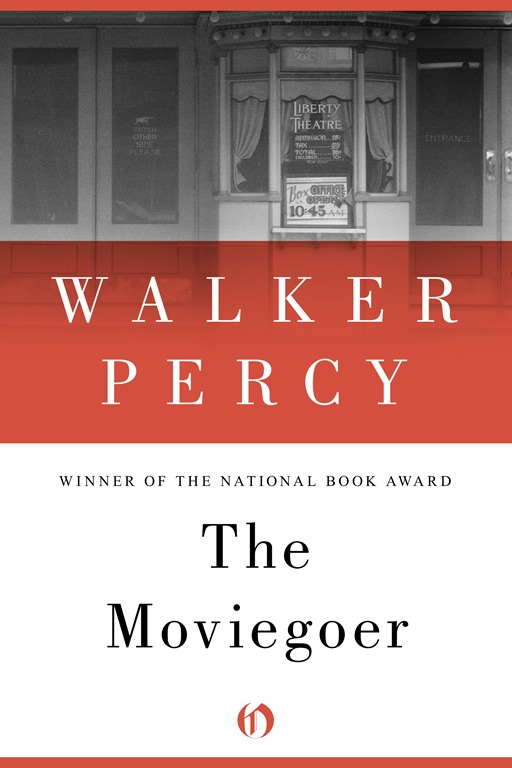
MovieGoerThe Moviegoer by Walker Percy tells the story of Binx Bolling, a young stockbroker existing in New Orleans of the 1050s.

Binx spends most of his spare time chasing his secretaries and watching movies.

At first glance, Binx seems the shallowest of people. But he often sees the world through fresh eyes, even if he struggles to articulate these observations to those around him.

Percy takes us through life in New Orleans and Chicago as seen through Binx's eyes. He likes adventure, but he is easily bored. He loves his family, but he cannot relate to them. He cares for his cousin Kate, but not enough to protect her.

We see Binx interacting with his extended family, a remnant of southern aristocracy, who lament the changing ways of their society. We experience his relationship with Kate, who recently attempted suicide. Without thinking how it might concern Kate's parents, Binx and Kate leave suddenly for a week in Chicago, without informing anyone of their departure.

"What do you think is the purpose of life - to go to the movies and dally with every girl that comes along?", his aunt asks him? He responds "No", but the reader suspects otherwise.

One might think this is a tragic tale, but it is told in a lighthearted fashion and it ends with some optimism.


GCast 48:

Angular pt 7: Routing

Routing in Angular is similar to routing in an MVC framework - except it happens on the client side. Learn how to implement it here.


Episode 563

J Tower on .NET Standard

J Tower describes .NET Standard, .NET Core, and the .NET Framework and how developers can get different flavors of .NET to work together.


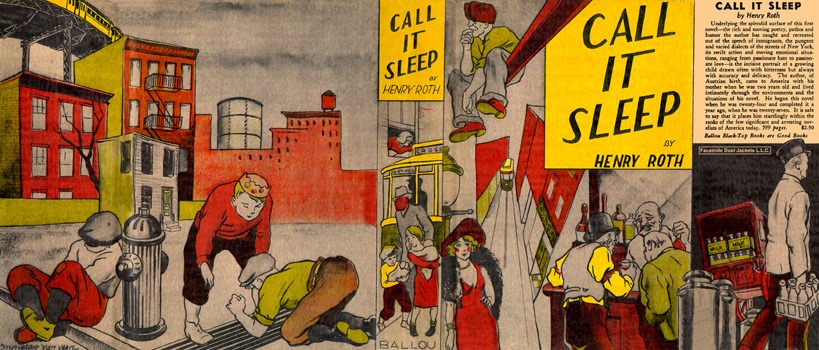
CallItSleepDavid's mother brought him to New York City from eastern Europe as a baby. Call It Sleep by Henry Roth follows young David through his first eight years, growing up in the tenements of early twentieth century New York City.

Life on the lower east side of Manhattan has been hard. Hard because the family struggles to make ends meet; hard because the quiet sensitive David is bullied by the other neighborhood boys; but, mostly hard because of David's abusive father Albert, whose temper and paranoia often prevent him from even holding down a job. Albert frequently takes out on his frustration on his young son.

David is sensitive and quiet and clings to his mother. His lack of assertiveness makes him an easy target for those who use him or bully him or blame him for their own mistakes. And there is no shortage of people in his world anxious to do this - from neighborhood kids to the local rabbi to his bratty cousins. The more the world troubles him, the more he clings to his mother for protection.

There is a constant tension between all the characters - partly the result of the stress of being a struggling immigrant in an unfamiliar country, but mostly because of Albert and his temper. And Roth does a good job bringing us into their lives and making us feel their angst.

When the point of view switches to young David, Roth often gives us an eloquent description of David's impressions of the world around him. But when angst overtakes the boy, Roth switches to a stream-of-consciousness inner dialogue, revealing young David's angst through incomplete sentences and phrases.

There is a lot of dialogue in this book and much of it is spelled phonetically to indicate the European or Bowery accents of the speaker. Add to that the occasional Yiddish word and this can be a difficult book to read.

But it is a good story that will make you feel for the characters trapped in it.


AlGreenA pile of roses sat on a table far at stage left.

The band entered the stage and played a few minutes of a funky groove before Al Green walked out and picked up a handful of flowers and handed or tossed them to ladies in the audience. He repeated this gesture multiple times during his  performance.

This was an appropriate beginning to Green's performance. He did not as much perform for the audience as he charmed them. And, for the most part, they were delighted to be charmed.

It was Green's first tour in seven years and his stop in Chicago Tuesday night was a popular one.

The audience sang along to songs that were never pop hits. But, when he played some of his most popular songs ("Let's Stay Together", "Here I Am", "Tired of Being Alone", "I'm Still In Love With You"), everyone rose to their feet in appreciation.

I remember these songs as soulful melodies, delivered at a slowburn pace. But Green's band (9 instrumentalists + 3 backing vocalists) increased the tempo, delivering each one a little funkier than the original.

Green played mostly R&B and soul, but mixed in a bit of Gospel music. Al Green is an ordained minister with his own church in Memphis and he moved us with his rendition of "Amazing Grace". A medley of songs by the Temptations ("My Girl"), the Four Tops ("Sugar Pie, Honey Bunch"), and Otis Redding ("Dock of the Bay") pleased the audience.

The band closed with a rousing rendition of "Love and Happiness".

At 73, Rev. Green is a few years older, a little thicker in the waist, and lacks some of the energy he possessed during his popularity of the 1970s and 1980s. His performance lasted only about an hour and did not include an encore; but he still can hit the high notes that made him famous; and he still projects joy while singing the songs that brought joy to so many of us during our youth.


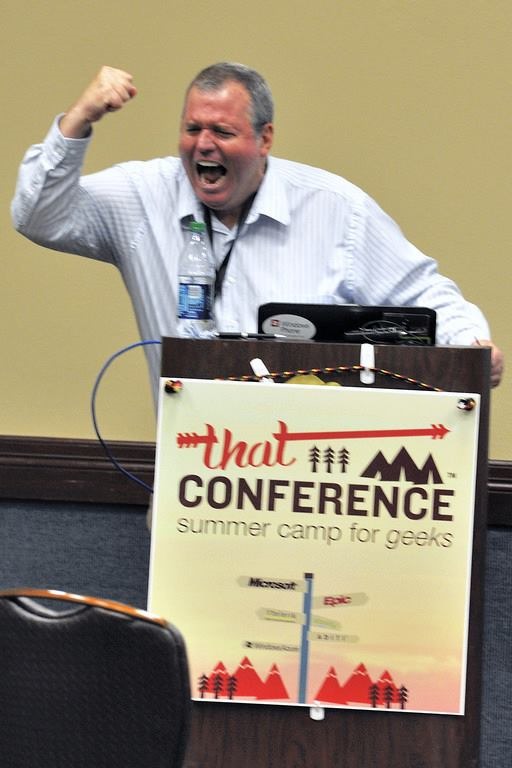
DavidAtThatConferenceLately, I’ve done less public speaking than in past years. But I still have a few presentations scheduled.

I will be delivering a presentation titled "We Want the Func! Using Azure Functions to Ease Deployment" at the following events:

Date Event Location
May 11, 2019 Chicago Code Camp Chicago, IL
May 23, 2019 DevSum Stockholm, Sweden
July 22, 2019 Chicago Cloud Conference Chicago, IL

In addition, I will present "How Cloud Computing Empowers a Data Scientist" August 8, 2019 at the PASS Cloud Virtual Group – an online user group.


GCast 47:

Angular pt 6: Services

Learn how to use Services in Angular to separate functionality and take advantage of dependency injection.


Keeping a computer system available all or almost all the time is a challenge.

Sometimes software patches or upgrades need to be installed on a server. Sometimes, old hardware needs to be replaced. Sometimes, hardware unexpectedly fails. Sometimes power to building or part of a building fails.

All these things can contribute to downtime - some of it planned and some of it unplanned.

Monitoring, redundancy, and planning all reduce the risk of downtime in Azure.

Many resources in Azure are written in triplicate. Only one copy of that data or service is live at any given time. The other two exist in case the live copy becomes unavailable. If this happens, Azure will automatically route requests to one of these "backup" copies. The live copy is sometimes called a "hot" copy, while the 2 redundant backups are sometimes referred to as "cold" copies.

This works well during planned software and hardware upgrades.  The cold copies' servers are upgraded first; then, new requests are routed to one of the upgraded cold copies, making it the hot copy, before the original hot copy is upgraded. Azure maintains something called "Update Domains" to help manage this. Systems in separate Update Zones will not be shut down for upgrades simultaneously, in order to avoid downtime.

Unexpected downtime is harder to manage. This is typically caused by hardware or software failure or a failure of a system, such as a power supply on which a service depends. All hardware fails at some point, so this must be dealt with.

To handle these failures, Azure continuously monitors its systems to determine when a failure occurs. When a failure on a hot copy is detected, requests are routed to a cold copy; then, a new copy of the service or data is deployed onto available hardware in order to maintain 2 redundant cold copies. Redundant copies of a service are kept in different parts of a datacenter, so that they don't rely on a single point of failure. These independent parts of the data center are known as "Fault Domains" because a fault in one Fault Domain will not affect services in the other Fault Domains.

As a result of these practices, Azure can guarantee a certain level of uptime for each of its paid services. The level is dependent on the service and is usually expressed in terms of percentage uptime. Azure guaranteed uptimes range from 99.5% to 99.99%. This guaranteed uptime percentage is known as a "Service Level Agreement" or "SLA"

You can view the current uptime guarantee for each Azure service here.

An uptime of 99.5% would be down a maximum of 1.83 days per year and an uptime of 99.99% would be down a maximum of 52.6 minutes per year.

Azure guarantees this by agreeing to credit all or part of a customer's charges if the uptime target is not met in any given month. The exact credit amount depends how much the target is missed.

As of this writing, here are the guaranteed uptimes for each Azure service.

Service Uptime Notes
Active Directory 99.90%
Active Directory B2C 99.90%
AD Domain Service 99.90%
Analysis Service 99.90%
API Management 99.90%
App Service 99.50%
Application Gateway 99.50%
Application Insights 99.90%
Automation 99.90%
DevOps 99.90%
Firewall 99.50%
Front Door Service 99.99%
Lab Services 99.90%
Maps 99.90%
Databricks 99.50%
Backup 99.50%
BizTalk Services 99.90%
Bot Service 99.90%
Cache 99.90%
Cognitive Services 99.90%
CDN 99.90%
Cloud Services 99.50% Assumes at least 2 instances
VMs 99.50% Assumes at least 2 instances
VMs 99.90% Assumes Premium storage
CosmosDB 99.99%
Data Catalog 99.90%
Data Explorer 99.90%
Data Lake Analytics 99.90%
Data Lake Storage Gen1 99.90%
DDoS Protection 99.99%
DNS 100.00%
Event Grid 99.99%
Event Hubs 99.90%
ExpressRoute 99.50%
Azure Functions 99.50%
HockeyApp 99.90%
HDInsight 99.90%
IoT Central 99.90%
IoT Hub 99.90%
Key Valut 99.90%
AKS 99.50%
Log Analytics 99.90%
Load Balancer 99.99%
Logic Apps 99.90%
ML Studio 99.95%
Media Services 99.90%
Mobile Services 99.90%
Azure Monitor 99.90%
Multi-Factor Authentication 99.90%
MySQL 99.99%
Network Watcher 99.90%
PostgreSQL 99.99%
Power BI Embedded 99.90%
SAP HANA on Azure Large Instances 99.99%
Scheduler 99.99%
Azure Search 99.90%
Security Center 99.90%
Service Bus 99.90%
SignalR Service 99.90%
Site Recovery 99.90%
SQL Database 99.99%
SQL Data Warehouse 99.90%
SQL Server Stretch Database 99.90%
Storage Accounts 99.99% 99.9% for Cold Storage
StorSimple 99.90%
Stream Analytics 99.90%
Time Series Insights 99.90%
Traffic Manager 99.99%
Virtual WAN 99.95%
VS App Center 99.90%
VPN Gateway 99.95%
VPN Gateway for VPN or ExpressRoute 99.90%
Information Protection 99.90%
Win10 IoT Core Svcs 99.90%
VMWare Solution 99.90%

Services like Azure Backup and Azure Functions, which can be easily retried, have the lowest guaranteed uptime.

The highest guaranteed uptimes are reserved for mission-critical services, such as DNS and Traffic Manager, along with all the database and storage offerings.

Free services are not listed here, as they almost never have a guaranteed uptime. Even if they did, there is nothing to credit to the account.

Azure has systems in place to guarantee high availability and reliability and Microsoft has enough confidence in those systems to guarantee a predictable level of uptime and base that guarantee on monetary credits.


Saturday, I passed the Microsoft Azure Fundamentals exam (AZ-900).

The topics covered for this exam are listed here.

It had a lot of general knowledge question (a few where you just needed to know the difference between IAAS and PAAS). But there were some trivia questions, as well.

I studied for 2-3 days and got an 850.

Here is how I prepared:

  1. I completed this 12-module course, which took about 8 hours: Azure Fundamentals course
  2. I reviewed this PowerPoint deck: AZ-900 Certification Training, created by Daniel Baker.

While studying the above 2 resources, if I found any service with which I had no experience, I opened the portal and created that service and poked around in it a bit. I found it stuck in my memory much better when I did that.

Also, I kept open a text document while studying, in which I listed any topics that I did not know or felt weak in. After studying, I returned to this and reviewed these topics multiple times.

Related to this practice, I saved a copy of the above deck and deleted the slides covering topics I felt I knew well. I reviewed the remaining slides until I could read the title and articulate the ideas covered by that slide.

This was probably the least technical Microsoft certification exam I've taken. It wasn't difficult, but it did require some preparation on my part. I've worked in Azure for years, but I don't think I would have passed without studying. There were too many questions about support options and SLAs and other things I don't spend much time on.


Episode 562

Mike Benkovich on Visual Studio 2019

Microsoft MVP Mike Benkovich discusses the important new features in Visual Studio 2019


April 2019 Gratitudes

Comments [0]

5/5
Today I am grateful to pass an Azure certification exam yesterday.

5/4
Today I am grateful to chat yesterday with people from 3 different continents.

5/3
Today I am grateful to attend the AUVSI XPONENTIAL conference this week and see some amazing uses for drones.

5/2
Today I am grateful to see "Avengers: Endgame" with Tim last night.

5/1
Today I am grateful I did not have to go out in the storm the last couple days.

4/30
Today I am grateful I was able to figure out my son's CRM questions yesterday.

4/29
Today I am grateful for a walk around Park Ridge yesterday.

4/28
Today I am grateful:
-to participate in this year's Global Azure Boot Camp yesterday
-for a visit from my son Nick this weekend.

4/27
Today I am grateful for my first visit to Ottawa when the temperature was above freezing.

4/26
Today I am grateful to successfully complete a project we have been working on for months.

4/25
Today I am grateful I've managed to keep up this "Daily Gratitude" thing for 6 years.

4/24
Today I am grateful for an excellent ramen dinner with my team last night in Ottawa.

4/23
Today I am grateful to arrive safely in Ottawa after many delays.

4/22
Today I am grateful to spend Easter in Michigan with my siblings and their families.

4/21
Today I am grateful to attend the first playoff game at Little Caesars Arena, which was also my first time seeing the Pistons at LCA.

4/20
Today I am grateful for lunch in East Lansing, MI yesterday.

4/19
Today I am grateful to David, Mike, and J. for answering my technical questions yesterday .

4/18
Today I am grateful for a walk around Glencoe Beach yesterday evening.

4/17
Today I am grateful for the opportunity to learn something new every day.

4/16
Today I am grateful for people who reach out unprompted to see how I'm doing.

4/15
Today I am grateful to learn the TV in my building's Community Room has HBO.

4/14
Today I am grateful for this view before I go to bed each night.

4/13
Today I am grateful to finish preparing my taxes in time.

4/12
Today I am grateful to watch lightning splash across the downtown sky last night.

4/11
Today I am grateful for good Project Managers who take over some of my headaches.

4/10
Today I am grateful for good news (I.e., no news) from my surgeon at my follow-up appointment yesterday.

4/9
Today I am grateful to wake up to this view every morning.

4/8
Today I am grateful to spend hours in Andersonville coffee shops yesterday afternoon, reading a detective novel.


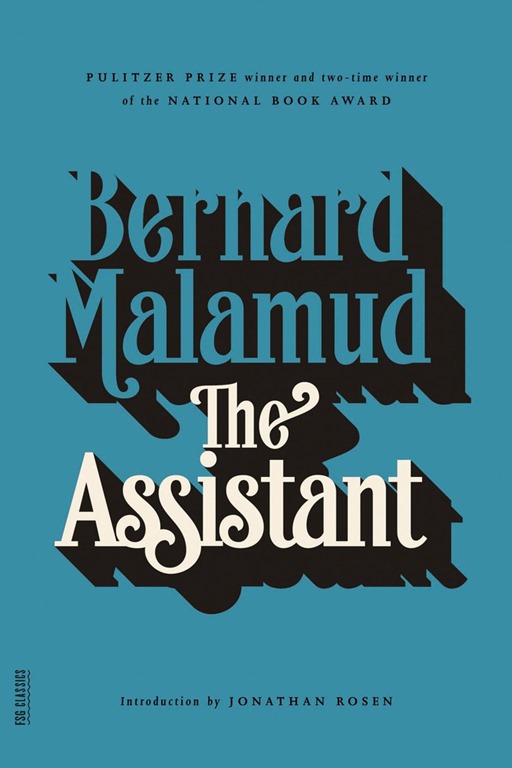
AssistantFrank wants to be good. But he keeps doing bad things - really bad things, like armed robbery and rape. Still, he tries to make up for it. Most of the harm he causes is to the Bober family, an immigrant family struggling to keep their Brooklyn grocery store going.

So, Frank volunteers to work in the store at slave wages to make up for his sins. Customers like him and business increases. The family is kept from destitution by Frank's hard work and the fact that he sneaks some of the money he stole back into the cash register.

But soon, he is stealing again from the cash register. And trying to redeem himself again.

The Assistant by Bernard Malamud focuses on 3 characters:

Morris Bober, the impoverished, long-suffering Jewish immigrant grocery store owner. He works 18-hour days, but sees his business and savings evaporating.

Helen Bober, Morris's bright daughter, who defers her dreams of college in order to help support her family.

Frank Alpine, an Italian-American orphan, struggling to survive and to regain his lost morality.

Frank and Helen fall in love, to the horror of their parents, who disapprove of the gentile Frank. And as Morris grows older and weaker and frailer, Frank works himself sick to help the family that he feels he owes.

Ultimately, Frank succeeds the overworked, suffering Morris as his ultimate atonement.

Through Frank's story, Malamud shows us that we are all capable of redemption - no matter how terrible our sins.


GCast 46:

Angular pt 5: Master Detail Components

Continuing the Angular tutorial: Learn how to coordinate the data-bound items in a list with a component showing the selected item.


Episode 561

Adam Hecktman on Civic Tech

Adam Hecktman describes Civic Tech and what Microsoft is doing to help the city and people of Chicago.


It was the early 20th century and ragtime black pianist Coaltrain Walker was returning from New Rochelle to New York City after visiting his fiancée Sarah and their infant son, when he was accosted by a group of white firemen, led by Chief Will Conklin. The firemen demanded he pay a "toll" for driving on their road. While Walker went to fetch a policeman, the firemen vandalized his new car. The policeman took the side of the racist vandals. Soon after, Walker's fiancé died when after being struck by a policeman and receiving inadequate medical attention.

Coaltrain Walker quickly took action. He firebombed the station where he was harassed, he demanded the surrender of Conklin, he demanded the repair of his car, and he demanded an apology. Ripple effects were felt - not only by the society who learned of his violence - but by the white family that had assisted him and his family.

"Ragtime" by E.L. Doctorow looks at race relations in this country

Coaltrain's isn't the only story in this novel, but it is the most important. And the other stories and characters weave together imaginatively. For example, Tateh, a character introduced early in the novel (he is an impoverished artist, who is assisted by the former lover of Mother's Little Brother) reappears later as a fake Baron who makes animated movies.

"Ragtime" attacks race relations in America head on. Often, even those whites who are helpful to blacks still see them as inferior. Walker's experience is insulting enough that we feel sympathy for him, even as he resorts to vigilantism.

There is a network of people affected by this story. We never know the names of some of the most important ones - for example, the family that takes in the fiancée and baby are identified by names like "Father" and "Mother" and "Mother's Younger Brother"; and some are well-known historical figures, such as J.P. Morgan, Harry Houdini, and Robert Peary.

But Doctorow takes us on a journey through many lives and the effects they have on one another.


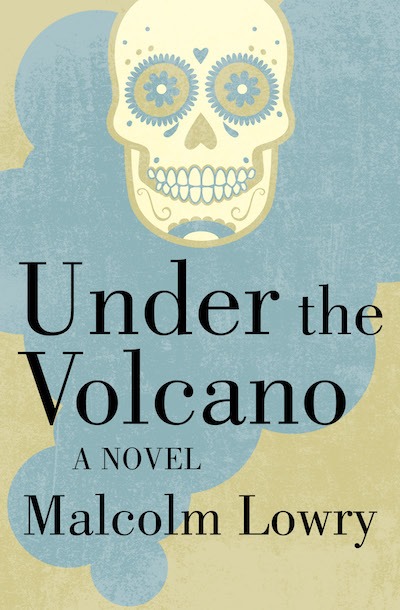
UnderTheVolcanoUnder the Volcano by Malcolm Lowry takes place almost entirely on a single day - The Day of the Dead in Mexico. It is the day that Geoffrey Firmin's estranged wife Yvonne returns after a year apart, in an attempt to save their marriage. But it is too late. His current relationship with alcohol has replaced his previous relationship with his wife.

It is the last day of Geoffrey Firmin's life.

Geoffrey misses and loves his wife, but he destroys his chance, spending the entire day in a drunken haze, sliding into self-destruction. He is clearly a high-functioning alcoholic and he tests this by drinking more and more as the day goes on.

The novel gives us a look into the mind of Geoffrey, his wife, his brother Hugh, and his old friend Jacque. We get a peek into their actions and memories, and (in the case of Geoffrey) hallucinations. It gives us a look at the problems of substance abuse and the denial inherent in those who suffer it.

Beer, whiskey, tequila, and mescal lead the protagonist on a downward spiral. We know where it ends; but, like a highway accident, we cannot look away.

The title refers to the two volcanoes that loom above the central Mexican City of Quauhnahuac, where the action takes place; but, also to all the unspoken conflict below the guilt and anger felt by the main characters.

Those who know me well will know what memories Geoffrey's behavior triggered in me. In Geoffrey, I saw a version of myself in a period of my life when I embraced the pain inflicted by another, rather than attempting to heal my wounds. Fortunately, I emerged from my self-destructive behavior and recovered (mostly).

Geoffrey did not.


GCast 45:

Angular pt 4: Displaying a List

Learn how to use Angular to bind to a list of items and iterate through that list.


Episode 560

Frank Gill on Azure SQL Database Managed Instances

DBA Frank Gill discusses Azure SQL Database Managed Instances - a cloud-based managed database service. He describes what they are, how they differ from Azure SQL Databases, and when it is appropriate to consider them.

Links:

https://skreebydba.com/
https://twitter.com/skreebydba


AreYouThereGodI have vivid memories of my childhood. I can remember the names of my teachers and of many of my classmates and what the classroom looked like and how it felt when I moved from Maryland to Michigan and had to adjust to a new school. I remember the peer pressure and the angst of feeling like I didn't fit in. I remember noticing girls and not knowing why or what the big deal was or who I would or should be attracted to.

Reading Judy Blume's Are You There God? It's Me, Margaret brought back a lot of those memories and feelings.

11-year-old Margaret Simon moves to a new town and a new school just before sixth grade. She struggles with a lot of things, but one of her main struggles is with her religious identity. Her parents - one raised a Christian and the other raised Jewish - abandoned their religions when their parents objected to their mixed marriage. As a result, Margaret grew up without religion. She feels that she lacks a sense of belonging to a community. As she puts it, she doesn't know whether to join the Y or the Jewish Community Center.

Margaret does have a very personal relationship with God, and she talks with Him frequently, always beginning the conversation with the book's title. She finds comfort in this relationship, but sometimes grows frustrated at God, who does not answer her directly.

I absolutely loved this book! Margaret felt very real to me. It took me back to my 11-year-old self and all the conflict I felt at that time and how important everything seemed to me. When Margaret discovered one of her friends lying, I recall the pain and disillusionment of exactly that same experience. When she described the peer pressure, I could instantly relate, as pre-teen me was overwhelmed by such pressures.

Some of Margaret's issues are exclusive to girls (bras, boys and menstruation); but many are common to both boys and girls of that age. We all struggled to find an identity and our place in the world. Margaret shows us how.


GuyInChicagoSpoiler alert: I've never seen "Diners, Drive-Ins, and Dives", the popular Food Network show in which restaurateur and food-lover Guy Fieri visits good restaurants around the world and shows off their tasty offerings.

But I'm aware of the show and my understanding is that Guy won't televise a visit unless he likes the restaurant. It's likely he won't even visit a restaurant unless someone on the staff has vetted its quality and recommended it.

I'm also aware that Guy has visited 30 restaurants in Chicago. I know this because many of these restaurants proclaim his visit with a large sign and a photo of Guy sporting his trademark grin and spiky hair. Last year, I found the complete list of Chicago restaurants visited for the show and I decided to try them all for myself.

It turns out that 4 of the visited restaurants (Galewood Cookshack, The Depot American Diner, Panozzo's Italian Market, and Chicago Brauhaus) have closed since Guy's visit and that one (Cemitas Puebla) has changed locations. Looking down the list, I saw that I had already visited 4 of them (Smoque, Tre Kronor, Big & Little's, and Saucy Porka)

This left me with 22 remaining restaurants that I had yet to taste.

Game on!

Earlier this week, I visited Tufano's Vernon Park Tap, completing my quest to enjoy a meal at every restaurant.

My conclusions:

There were no bad restaurants in the list. Guy and his staff do their homework, so each one was worth visiting. In some cases, it has been years since Guy's visit; yet the quality of each restaurant remains good.

Not all the restaurants are dives. There were some very nice bistros and tapas bars included and the prices at these places reflected their upscale image.

There were a few outstanding restaurants on the list. My favourites were:

  • 90 Miles Cuban Cafe. I sampled a variety of their Latin-American dishes and all were great.
  • bobNGrill. Creative fusion of hamburgers with Korean spices.
  • La Scarola. The best Italian restaurant I've ever experienced.
  • Smoque. Not quite up to Texas standards, but this place has the best BBQ in Chicago.

There was a lot of variety in the styles of food. I tasted Italian, Mexican, BBQ, Kosher, hamburgers, and a lot of fusion recipes.

Of course, this journey also gave me a chance to explore many different neighborhoods in Chicago. The restaurants tended to be located in the northeast quadrant of the city, which is where most tourists go; but this is a big area and they were scattered throughout.

Chicago has an excellent culinary culture and this show helped me to discover a bit more of it.

Now, I should probably watch the show.


GCast 44:

Angular pt 3: The Hero Editor

Learn how to do 1-way and 2-way data binding in Angular


Episode 559

Lwin Maung on IoT Hardware Options

Lwin Maung shows us various IoT devices and describes the differences between them and the uses for each.


IClaudiusTiberius Claudius Caesar Augustus Germanicus, better known as "Claudius" was a small child afflicted with a limp and a stammer. His family assumed he was mentally impaired, and he spent most of his time studying and writing history. So, he was largely ignored as other members of his family conspired to rule the Roman Empire.

In I, Claudius, Robert Graves gives a first-person narrative of Claudius's life and the early Roman Empire and those that shaped it.

The story begins with the assassination of Julius Caesar and the ascension of Augustus as the first Roman Emperor a few decades before Claudius's birth in 10BC. It concludes with the assassination of the Emperor Caligula, which led to Claudius being named Emperor.

In between are numerous assassinations, betrayals, and political maneuverings as many vie for power in the Empire.

Claudius is the perfect narrator because he is close to the power, without being part of the power. Through him, we encounter some startling evil people, such as:

Claudius's grandmother Livia. She is ruthless in her quest to see her line on the throne - destroying and murdering rivals, including some in her own family.

Caligula, whose extravagance quickly bankrupts Rome when he becomes Emperor, so he resorts to arresting and executing rich men to justify stealing their fortunes.

Tiberius, whose paranoia prevents him from effectively ruling his Empire.

In fact, we encounter very few good people in this "autobiography" (or "Game of Romes", as I like to call it). In addition to murder and assassination, many in power see nothing wrong with incest, adultery, and robbery.

Claudius survives because everyone underestimates him. No one considers him a threat or rival, thanks to his bookishness, submissiveness, and physical shortcomings.

I cannot attest to the historical accuracy of this novel, but I've read that Graves did extensive research before writing it. I can tell you that it is very entertaining. If you enjoy a story of political intrigue and conspiracies, you will likely enjoy I, Claudius.


Femme fatale? Check.

Wisecracking Private Investigator? Check.

Corrupt police chief? Check.

Ruthless criminals? Check.

Fixed boxing match? Check.

Double-crosses? Check.

Back-stabbing (both literal and figurative)? Check.

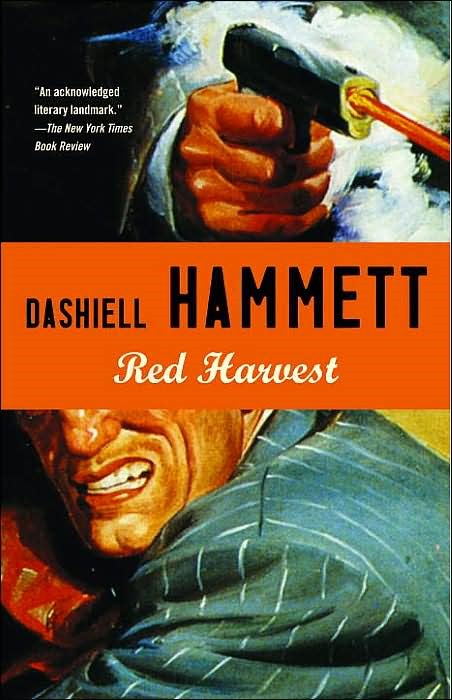
RedHarvestThese elements are cliché in the noir genre of film and books. But, in 1929, when Dashiell Hammett published Red Harvest, the genre was in its infancy. It was Hammett's success that led others to copy these elements so much that they became clichés.

The unnamed narrator - a private investigator from San Francisco is called to meet with a newspaper publisher in the small town of Personville. Personville is so infiltrated with mob corruption that many people call it "Poisonville". This nickname is reinforced when the publisher is murdered before the narrator meets with him.

The narrator (often referred to as "The Continental Op", because he is an operative for the Continental Detective Agency) is then hired by the murdered publisher's father Elihu Willsson, the most powerful man in town to investigate his son's murder; then to clean the town of corruption. When the Op solves the murder, Willsson tells him to forget about cleaning up the town, but the Op decides to do it anyway.

He does so by setting the rival mobs against one another and the corrupt police force.

As a detective story, Red Harvest does not offer much. Many of the crimes are solved when someone confesses. But as an action story, it is remarkable. Dozens of people are killed in the gang war. And as a study in character, it holds up well. We never know quite what motivates The Op to continue his quest to clean up the town. He is nearly framed for murder for his troubles.

Although Red Harvest falls short of being a classic, its influence on literature and film noir cannot be ignored. And it is a fun read.


GCast 43:

Angular pt 2: The Application Shell

This video walks you through creating the application shell for the Angular Tutorial at angular.io


Episode 558

Melanie Adcock on TechMonthChicago

Melanie Adcock has a passion for the Chicago tech community
She organizes TechMonth Chicago each October to shine a light on the numerous activities at meetups, startup incubators, public libraries, and schools in the city. This includes a website, a printed newspaper, and a semi-monthly radio show on Lumpen Radio 105.5 WLPN.

Links:

http://lumpenradio.com/techscene.html

http://techcopyauthority.com/

https://techmonthchicago.com/


March 2019 Gratitudes

Comments [0]

4/7
Today I am grateful for the Spring Brunch in my building yesterday.

4/6
Today I am grateful for a mid-day nap.

4/5
Today I am grateful I can work from home when it makes sense.

4/4
Today I am grateful
-to have the opportunity to mentor Hubbard High School students with their STEM projects this year.
-to see Mott the Hoople in concert last night

4/3
Today I am grateful to make it back to the gym yesterday for the first time since my surgery.

4/2
Today I am grateful to attend the NCAA Women's Regional Basketball Final in Chicago last night.

4/1
Today I am grateful for:
-Spending the day with Tim
-Lunch with Tim and Natale yesterday
-The Spartans in the Final Four after an exciting victory over the most talented team in the country

3/31
Today I am grateful to attend a hackathon at Georgia Tech this weekend.

3/30
Today I am grateful to visit the Jimmy Carter Presidential Library and Museum yesterday.

3/29
Today I am grateful to attend an OpenHack this week in Chicago and learn a lot about managing data in Azure.

3/28
Today I am grateful to see Nick Moss and Dan Carelli at Buddy Guy's Legends last night.

3/27
Today I am grateful that so many others from the CSE team are in Chicago this week.

3/26
Today I am grateful for dinner with Brent last night.

3/25
Today I am grateful for an exciting NCAA basketball tournament.

3/24
Today I am grateful to deliver my first community presentation of 2019 yesterday.

3/23
Today I am grateful to the lady who comes to my home every month to clean it.

3/22
Today I am grateful to spend time yesterday with my team.

3/21
Today I am grateful to work from home for a few days while I recover.

3/20
Today I am grateful for good health insurance.

3/19
Today I am grateful for everyone's prayers yesterday.

3/18
Today I am grateful to witness the Spartans win another championship at the United Center yesterday.

3/16
Today I am grateful for lunch with Nick yesterday

3/15
Today I am grateful
-to deliver a guest lecture at Michigan State University yesterday
-to see "Miss Saigon" in East Lansing with Amanda last night.

3/14
Today I am grateful for bike-riding weather.

3/13
Today I am grateful for the new speaker on my TV.

3/12
Today I am grateful for a choice of many coffee shops to work in when I feel like it.

3/11
Today I am grateful for 3 days in Bellevue.

3/10
Today I am grateful to be part of a successful IoT hackathon at T-Mobile this weekend.

3/9
Today I am grateful for breakfast with Josh yesterday.

3/8
Today I am grateful for 4 days in Toronto - one of North America's great cities!

3/7
Today I am grateful to learn so much about IoT and Azure this week.

3/6
Today I am grateful for dinner last night at the top of the CN Tower overlooking downtown Toronto.

3/5
Today I am grateful that my son sometimes calls me just to chat.

3/4
Today I am grateful to see "Hamilton: The Musical" yesterday.

TheHeartOfTheMatterGeorge Scobie is a British policemen, who has been living and working in a west African colony for the past 15 years. World War II now rages around him, but he and is wife Louise are isolated in a small port city, far from the civilization they knew. The love has long evaporated from their marriage and Louise is unhappy with her life and begs George to buy her a ticket to South Africa. George cannot afford the ticket on his small salary, so he borrows the money from a local black marketer of questionable scruples. After Louise's departure, George begins an affair with the recently-widowed Helen Rolt.

This is the happy plot of The Heart of the Matter by Graham Greene.

It is not an adventure story because very little action takes place. It is not a love story, because George clearly does not know what love is, although he tells himself that he does.

It is an exploration of the mind and sould of a weak, but well-intentioned man, who struggles with morality and his choices and his sins.

George Scobie tries to be a good man; but he is never honest with himself - even deluding himself into believing his affair is kept secret from others in town. He is weak: He recognizes and confesses his sin; but is powerless to keep stop from repeating it. His best trait is that he does not want to hurt anyone. He is motivated by pity (an emotion he often mistakes for love) and he tries to find a solution that will hurt neither Helen nor Louise. Invevitably, everyone is hurt by his inactions.

Scobie is a practicing Catholic, but he cannot go to confession because he knows his adultery will continue and, therefore, will not receive absolution. He is tempted by suicide, but his religion has taught him this is an unforgiveable sin that will result in eternal damnation.

In the end, this unrepentant sinner rationalizes a path that he thinks will hurt the least number of people; but, ultimately has no positive impact on anyone.

The Heart of the Matter raises moral questions, but leaves it to the reader to answer them.


Yeah, it's a mighty long way down rock 'n' roll!
As your name gets hot so your heart grows cold!
And you gotta stay young man, you can never be old!
All the way from Memphis!

-Mott the Hoople

MottTheHoople (1)In 1974, Mott the Hoople recorded and released a live album, probably without realizing it would be their last. Ian Hunter's decision to pursue a solo career led to the band's breakup a few months after the album's release.

In 2019, the surviving members - guitarist/vocalist Hunter, keyboardist Morgan Fisher, and guitarist Ariel Bender - reunited to tour North America. Wednesday night, that tour landed at the Chicago Theatre and a legion of gray-haired and graying haired fans came to pay tribute.

The opening act was The Suburbs - a pretty good band from Minneapolis, whose music sounded like the synth-heavy, horns-enhanced music of 1990s MTV. The singer joked "As you can tell, we are very young", even though gray hair sat atop the heads of most of the band members. They filled a pleasant 40 minutes.

Around 9PM, the stage darkened, and the recorded music of Gustav Holst filled the theatre as Mott the Hoople marched onstage. The spotlight shone on Hunter and Fisher, who performed an acoustic version of the opening of Don McLean's "American Pie". After the line about "the day the music died", Hunter asked: "Or did it?" and the rest of the band launched into an energetic version of "The Golden Age of Rock 'N' Roll". They had begun the concert exactly as they had begun the 1974 tour!

For almost 2 hours, this trio and the five others in the band entertained a theatre full of aging rock fans. The band consisted of keyboards, guitars, bass, drums, and one virtuoso, who kept switching instruments.

MottTheHoople (2)Through power rock and rockabilly and ballads, the band kept the audience on their feet, singing along and cheering on the heroes of their youth. Mott the Hoople was known for great originals, like "All the Way from Memphis" and covers like Lou Reed's "Sweet Jane" and they played plenty of both on this night. Other highlights of the night were "I Wish I Was Your Mother", "Roll Away the Stone", and "Walking with a Mountain", which featured a blistering guitar solo by Bender. For local color, they sang the chorus of Hunter's hit "Cleveland Rocks", replacing the iconic line with "Chicago Rocks" to the pleasure of the locals. On the rock numbers, the band sometimes featured 4 guitar players - not counting the bass guitar.

Of course, they finished the night with David Bowie's "All the Young Dudes" - Mott the Hoople's biggest hit.

It was amazing how much the band sounds the same, despite 45 years apart and vocal chords and fingers that are in their seventh decade. More impressive was how much fun they seemed to be having and how that fun energy transmitted itself to an audience. Band members and audience members connected with one another and for a couple hours, it was as if all the years had not passed and we were all still young fans and rock gods.


GCast 42:

Angular pt 1: Getting Started

Learn how to install Angular and its prerequisites and build a simple Angular application using the CLI.


Episode 557

Brent Stineman on the Evolution of Serverless

Brent Stineman describes Serverless cloud technologies and how they have evolved to make applications more flexible.


IAmMalalaIt was October 9, 2012, just after noon. A group of Taliban terrorists boarded a bus in Swat District, Pakistan and shot 15-year-old Malala Yousafzai in the head. They targeted her for pursuing an education for herself and for promoting education for women - something The Taliban insist is forbidden by the Quran. They left her for dead.

But Malala did not die. Thanks to emergency medical attention in Pakistan, and further treatment in the UK, she survived to become an international advocate for female and youth education. Two years later, she was awarded the Nobel Peace Prize (the youngest Nobel recipient in history), and she wrote I Am Malala: The Story of the Girl Who Stood Up for Education and Was Shot by the Taliban - a book chronicling her story.

Malala describes her home province as a beautiful landscape that serves as a vacation destination for many Pakistanis; but it is also a battleground between the Pakistani army and the Taliban - a fundamentalist terrorist organization that seeks power for itself and strict adherence to Muslim law. They strive to achieve these goals through violence and intimidation.

Malala's story starts long before the attack on the bus. Her father Ziauddin ran the school that his daughter attended. He was progressive enough to allow girls into his school and generous enough to allow some of the poorer students to stay and eat at the family's home. Ziauddin was an outspoken proponent of education for all, which hid not endear him to groups like the Taliban. At a young age, Malala herself began writing an anonymous blog, promoting the right to education for all.

The book's writing style reminds us that Malala is still a school girl; but the message is a powerful, adult one: A young girl's courage to stand up to terrorism, violence, and oppression can inspire us all.

I became aware of Malala shortly after her recovery from the assassination attempt, when she began speaking publicly and meeting with international officials, such as Barack Obama and Queen Elizabeth. But I was unaware that she had been fighting for these things for most of her life. She was awarded Pakistan’s first National Peace Award for Youth at the age of 14 - an award that now bears her name.

She grew up during a turbulent time in northern Pakistan. National politicians largely ignored the remote region, except during elections. Political power in the district was concentrated among a few families. Drone attacks from the U.S. in the area and suspicion of U.S. spies led to a general distrust of America by the locals. The U.S. Military discovered Al-Qaeda leader Osama Bin Laden hiding in a compound a few miles from Malala's home and killed him during a raid. The Pakistani military did not assert its full power to maintain the safety of the citizens. All these factors allowed the Taliban to gain influence in the area and eventually assert control at least as strong as the Pakistani military. The Taliban arrived when Malala was 10 years old. They steadily increased their power in the region by recruiting the disenfranchised and by terrorizing any who disagreed with their interpretation of Islam.

I am Malala was co-written by British journalist Christina Lamb, but it still retains the voice of a teenage girl, concerned with her friends and her clothes and arguing with her brothers; but also recognizing the importance of what she and her father are doing. And having the courage to voice that importance. Malala Yousafzai miraculously survived an assassination attempt at point-blank range; and she seized the opportunity to spread her message throughout the world. This book is part of that.


GCast 41:

Using the PowerPoint Selection Pane

The Selection Pane is a little-used PowerPoint feature that can make it easier to manage a complex slide.


Episode 554

Bret Stateham on IoT Edge

Bret Stateham describes how to effectively use IoT Edge to move some of your processing and logic closer to your IoT devices.


RabbitRunHarry "Rabbit" Angstrom isn't much good at anything. In high school, he was an outstanding basketball player, but he has accomplished little since then. After tasting that early success, life feels empty at 26 - trapped in a boring job and a loveless marriage to an alcoholic wife.

So, one day, he abandons his pregnant wife Janice and their toddler son and moves in with a prostitute.

Rabbit - the main character of John Updike's 1960 novel Rabbit, Run - is decidedly unlikeable. He is self-absorbed and shallow and oversexed and manipulative. Still, those around him seem to like him and are more than willing to give him multiple chances to prove his integrity. It may be because he says and does whatever comes into his head. But his tendency toward immediate gratification is his main problem and often comes at a high cost to others. Rabbit never considers the consequences of his actions or the people he hurts as he runs from his responsibilities and obligations.

In particularly examples of self-absorption and manipulation, he coerces his lover into performing fellatio, because he learns she once did it for someone else. The next morning, he abandons his lover and returns to his wife without even a phone call. A few weeks later, he storms out of his apartment when his wife refuses to have sex with him shortly after giving birth.

Updike has a way of keeping the reader engaged, even during the most mundane moments. We see inside Rabbit's mind and feel his rationalizations. But the story isn't just about Rabbit. Updike tells the thoughts of the others in Rabbit's lives and their troubles. And many of them also run from their troubles - particularly Janice, who escapes into alcohol.

Of course, the most dramatic parts of the story are also engaging. I could not look away as Updike described the inevitable tragedy near the end of the book. Rabbit's wife is home with their baby, and she is drinking when "the worst thing that has ever happened to any woman in the world has happened to her." We see it coming a mile away, but it is still a shock, when it happens.

Rabbit, Run is a good look into the psyche of an American male trying to find himself, and what happens when he focuses too much on that goal.


GCast 40: IoT Hubs

Comments [0]

GCast 40:

IoT Hubs

Azure IoT Hubs allow you to send and receive messages between devices all over the world and Azure.


Episode 554

Kevin Griffin on Whats New in SignalR

Kevin Griffin returns to the subject of SignalR, describing the advances in this push technology since we last spoke of it years ago.


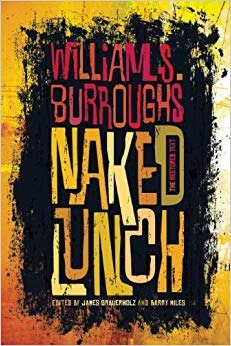
NakedLunchNaked Lunch by William S. Burroughs is a difficult book to read and to understand. I'm still not sure I do.

The book consists of a series of descriptions of the visions seen while high on heroine, morphine, or some derivative thereof. Many of the visions consist of deviant sexual fantasies, including sadomasochistic scenarios so extreme that they lead to murder and suicide.

Burroughs was one of the most famous writers of the influential "Beat Generation", although he never approached the fame and success of his friends Allen Ginsberg and Jack Kerouac

Burroughs spent much of his adult life in a drugged-out haze and many of the visions told here are based on his own experiences. "Naked Lunch” written largely in a drug-induced haze, which may have increase Burroughs's creativity; but it clearly pushed him toward a very confused story.

Shortly after its publication, Naked Lunch was banned as pornography in Massachusetts.

I disagree with attempts to ban this book; but I fail to see its value as a classic. It is a non-linear narrative with no discernable plot or story. Apparently, several of the characters are the same character with different pseudonyms. But I don't know how anyone could figure that out without being told. As a result, it is far less compelling than other non-linear classics, such as Joseph Heller's excellent Catch-22.

I respect the fact that Burroughs pushed boundaries in the literary world and that he influenced other writers. The author sometimes captures the paranoia and other-worldliness of drug addiction. But Naked Lunch tries too hard to shock the reader. I can only take so much talk of vomit and jizz and people shitting themselves before it all sounds like rambling.

I will give the book the credit it deserves for one thing: The great rock/jazz band Steely Dan took their name from a brand of sex devices described in Naked Lunch.


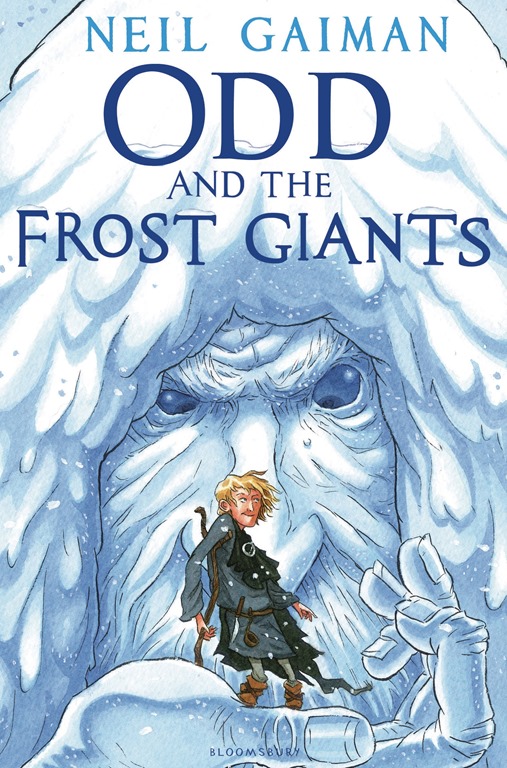
OddAndTheFrostGiantsNeil Gaiman knows how to tell a story. And Odd and the Frost Giants is no exception.

Odd was a crippled Norse boy in the age of the Vikings. Odd's father was dead, and his mother had re-married a neglectful man. One day, Odd rescued a bear and was followed home by the beast, along with an eagle and a fox. The three creatures turned out to be the gods Thor, Odin, and Loki transformed by an evil frost giant and cast out of Asgard, as part of a plot to steal Thor's hammer Mjolnir and to kidnap the beautiful goddess Freya.

Odd and the trio set out for Asgard to rescue Mjolnir and Freya.

Undersized and weak, Odd proves more valuable than expected.

This is a short, but delightful book - not only for its story and its characters - but for Gaiman's prose. One can imagine him sitting around a campfire and relaying the tale to a circle of Vikings who listen in wonder. As a bonus, each chapter features a beautiful ink drawing by Brett Helquist. Readers of "A Series of Unfortunate Events" will know his work; but, in this book, each drawing has the look of a woodcut, giving it a distinctly Nordic feel.

Odd and the Frost Giants is targeted at school-age children, but I am well into my 50s and I enjoyed it.


IMG_3727Not only did I fail to see "Miss Saigon" in the 20 years since its premier in London's West End, I failed to learn anything about the show. I didn't know who wrote it, I haven't heard a song, and I did not know the plot. I didn't even know that it is an adaptation of Puccini’s "Madame Butterfly" opera.

That all changed Thursday night at the Wharton Enter in East Lansing, MI. My niece and I braved a hail storm and flooded streets to grab second-row tickets to see a touring company as it passed through mid-Michigan.

To spoil it for those of you who did as little research as I did: Miss Saigon tells the story of Chris, an American G.I., who falls in love with Kim, a young Vietnamese girl during the Vietnam War. When Saigon falls to the Viet Cong, Chris escapes, but Kim does not. It's a tragic story of war and lost love and what might have been.

The performance at Wharton was wonderful,

Emily Bautista and Anthony Festa moved our hearts as the star-crossed lover.

But the show was stolen by "The Engineer" - a sleazy night club / brothel host/manager, who manipulates Kim and other women, but somehow gains some sympathy from the audience. I believe Thursday night's performance featured understudy Eymard Cabling, rather than the regular Red Concepcion in this role. Regardless, he played the character flawlessly.

Another scene-stealer was the micro-urchin who played Kim's son Tam. He had no lines, but he overwhelmed us with is cuteness every time he stepped on stage.

I didn't hear any hit songs, but he music of "Miss Saigon" always satisfied. Song flowed into song so frequently that there were fewer opportunities to applaud than most shows afford. There were no low points in a lovely musical score, which was carried well by the cast.

The stage setting was very impressive for a small-city touring company. The highlight was a helicopter that loomed over the U.S. Consulate in Saigon to rescue the last of the refugees before the city's fall. One could almost smell the diesel coming off this impressive effect.

The final scene left the audience in tears.

Our attendance was a late decision, but this was an evening very well spent and one I will remember for a long time. It was well worth a trek through the hail and floods.


Azure Search REST API

Comments [0]

GCast 39:

Azure Search REST API

Azure Search allows you to make your internal data searchable in the same way that search engines like Google and Bing make public information on the Internet searchable.


Sometimes, I like to build fancy automations in Microsoft PowerPoint.

PowerPoint provides a simple way to animate objects on a slide. The steps are:
Select an object,
choose an animation
Set properties (e.g. timing) of that object

When a slide has a complex animations, you can end up with a lot of objects to manage. Sometimes those objects are stacked on top of one another, as shown in Fig. 1.

sp01-OverlappingShapes
Fig. 1

This makes it difficult to select the desired object. Further, if some shapes look alike, it's difficult to know which one to select.

PowerPoint provides a feature to help with this: The Selection Pane.

It's a good bet you've never used the Selection Pane, because it is not obvious where to find it.

To show this pane, select the Home ribbon (Fig. 2); then, select Select | Selection Pane, as shown in Fig. 3.

sp02-HomeRibbon
Fig. 2

sp03-SelectionPaneButton
Fig. 3

The Selection Pane displays, as shown in Fig. 4.

sp04-SelectionPane
Fig. 4

Each object on the current slide is listed. Notice that it each item is given a generic name, based on the type of shape.

You can rename any shape by double-clicking the shape name in the Selection Pane, typing in a new name, and pressing ENTER, as shown in Fig. 5 and Fig. 6.

sp05-RenameObject1
Fig. 5

sp06-RenameObject2
Fig. 6

Fig. 7 shows all the objects with more meaningful names. When I'm working with a complex slide, I like to rename each object to something to easily identify it.

sp07-RenameAllObjects
Fig. 7

Clicking the icon to the right of each object name allows you to toggle the visibility of that object. Hiding objects on top of and around an object can make it much easier to select and work on a given object. Fig. 8 shows the slide with every object hidden except the 2 circles.

sp08-HideObjects
Fig. 8

When you are finished working on objects, click the icon(s) again to reveal the hidden objects.

The PowerPoint Selection Pane is a little-used feature that can make it much easier to work with animations and complex slides in PowerPoint.


In a previous article, we saw how to create an Azure IoT Hub.    

In this article, we will show how to add devices to the IoT Hub.

When I first began working with IoT hub devices, I was confused by language that suggested I was "Adding" or "Creating" a device. What we are really doing is registering a device with the hub, so that a physical device of the same name can communicate with this hub. When you see words like "Add" and "Create", think of the fact that it is adding and creating the registration entry.

To begin, log into the Azure Portal and navigate to your IoT Hub, as shown in Fig. 1.

id01-IotHubOverviewBlade
Fig. 1

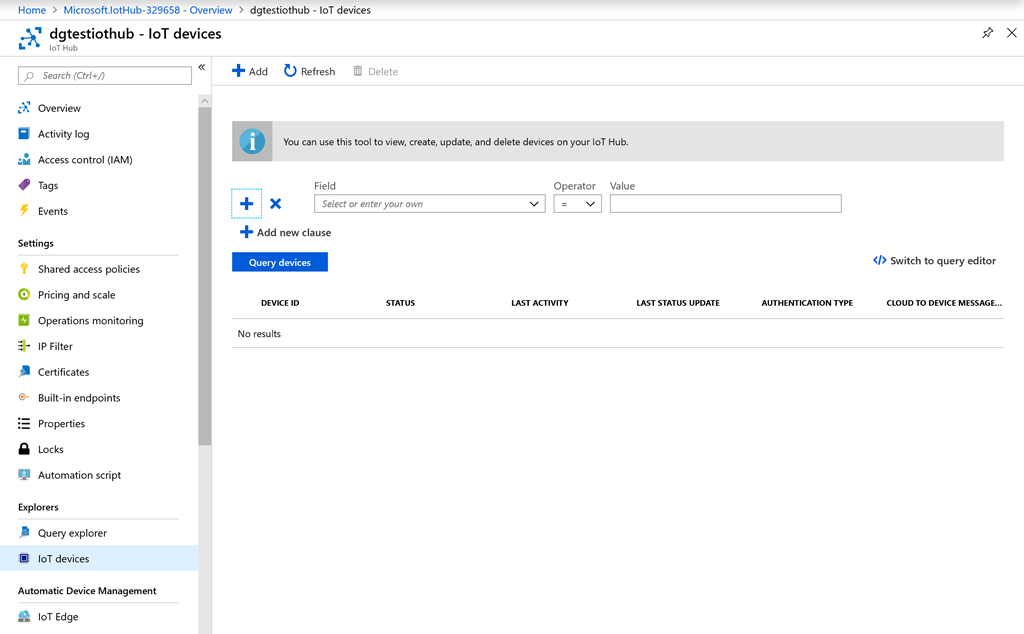
Click "IoT devices" to open the "IoT devices" blade, as shown in Fig. 2.

id02-IotDevicesBlade
Fig. 2

If this hub has any devices, you will see them listed. You can use the fields at the top to filter the list to more quickly find one or more devices.

To add a new device, click the [Add] button (Fig. 2) to display the "Create a device" blade, as shown in Fig. 3.

id03-AddDeviceButton
Fig. 3

id04-CreateADevice
Fig. 4

At the "Device ID", enter a name for this device. The name must be unique among this hub's devices.

At the "Authentication type", select the type of authentication you wish this device to use. If you select "Symmetric key", you have the option to enter your keys or allow the system to generate keys for you.

Click the [Save] button to create this device.

After a few seconds, the device is created and displays in the device list of the "IoT devices" blade, as shown in Fig. 5.

id05-IotDevicesBlade
Fig. 5

If you click on the device, you can see the "Device details" for this device, as showin in Fig. 6.

id06-DeviceDetails
Fig. 6

The connection string is required to target this specific device.

Now that you have a device registered, a device of that name can communicate with this hub.


Episode 554

Ondrej Balas on 2-Factor Authentication

Ondrej Balas discusses advances in 2-Factor Authentication and tells us how to add this security to our applications.


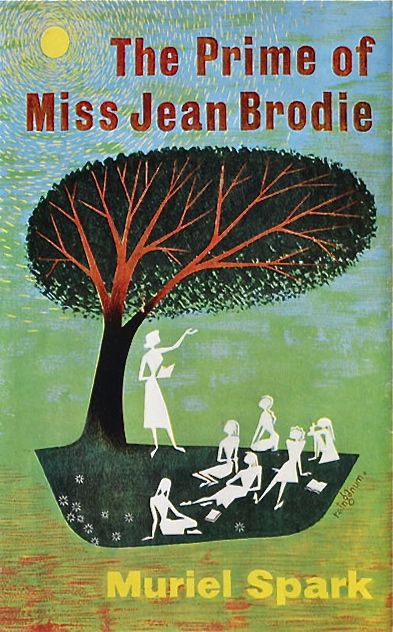
The Brodie Set were a group of six pre-teen girls at The Marcia Blaine School in Edenborough, who were completely devoted to their favourite Teacher - Miss Jean Brodie.

Miss Brodie was proud and eccentric. She refused to teach the defined curriculum - instead instructing girls on how to be proper young ladies or captivating them with tales of her travels and adventures. Miss Brodie believed she was in her prime and she let everyone know it. She would often brag "Give me a girl at an impressionable age and she is mine for life." "You girls are my vocation", she insists. "I am dedicated to you in my prime." This does not endear the teacher to the administration of this 1930s private school, who search for a reason to dismiss her.

The Prime of Miss Jean Brodie by Muriel Spark follows the girls throughout their school years, as they grow up under the influence of Miss Brodie, who takes them to museums and tea parties and to the homes of her friends. Brodie continues to be a strong influence on their lives, even after they graduate to the Senior school and she is no longer their teacher.

In some ways, Miss Brodie is a lovely person: She is bright and imaginative, passionate about art and music and history, and fiercely loyal to her girls. But in other ways, her flaws show through. She is an admirer of fascism in the years before World War II, showering compliments upon both Mussolini and Hitler.

Worst of all, she is manipulative of the girls she is mentoring. At one point, Brodie falls in love with a married teacher and, knowing she cannot have him, she conspires to have one of the girls sleep with him instead. She even makes sure another girl is with them to report back to Miss Brodie. The plan backfires when the art teacher begins an affair with the wrong girl.

The story often jumps ahead to the grown-up girls of the Set - sometimes by parenthetically revealing a bit about a girl's future ("Rose, who would later be famous for sex") and sometimes with an entire scene taking place among the older girls or with an aging Miss Brodie, who dies shortly after passing out of her "prime".
  Because of the flash-forwards, we know that Jenny will become a nun; that Mary will die young; that Rose will be famous for sex; and that Miss Brodie will be fired after being betrayed by one of her pupils. But the humor and intelligence of Spark's writing keeps the reader engaged until the end.

In fact, it is Spark's wit that kept me engaged throughout this short novel. She perfectly captures the eccentric schoolteacher and the teenage girls gossiping about school and sex and who they are and what they will become.

The Prime of Miss Jean Brodie is a short, but excellent novel about the effects - both positive and negative - that a strong role model can have on impressionable youth. It is told in a way to delight the reader.


Sometimes, the American dream is a reality. And sometimes, it is an illusion.

Seymour "Swede" Levov had the perfect life. He grew up tall and handsome and was the best athlete in Newark, New Jersey. After the war, Swede married Miss New Jersey, fathered a beautiful little girl, and began training to take over his father's glove factory. He was good at his job; his wife loved him; his daughter was perfect, except for a stuttering problem; he was successful at work.

Everybody body loved and admired Swede Levov.

Everybody envied Swede Levov.

But Swede's life was far from perfect.

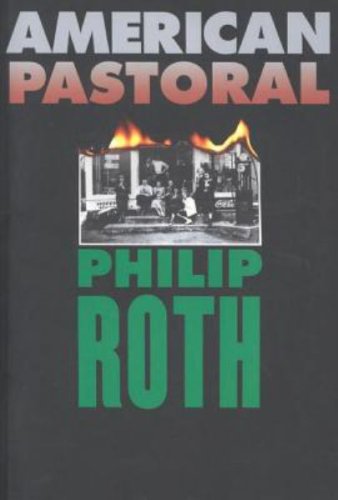
"American Pastoral by Philip Roth tells Swede's story.

In high school, Swede's daughter Merry became involved in the anti-Vietnam War movement; and, at the age of 16, she blew up the local general store and Post Office, killing a local physician. She disappeared that day.

Too much came easy for Swede. His great skill was excelling at those things that were expected of him; and he spent most of his life trying to do just that: He worked hard, he was kind to others, he loved his wife and daughter. He even kept his Newark factory open after the city was racked by riots and crime increased and it became impossible to hire high-quality craftsman. It wasn't enough.

Swede's idyllic life was an illusion. His outward success is a façade, hiding the turmoil and tragedy that plagued him and his family.
 
Swede searches (mostly) in vain for his daughter. His efforts result in disappointment and exploitation. Even when he finds her, he gains no closure from the incident. Merry has moved from her life as a violent terrorist; but now embraces a self-destructive philosophy that leaves her sick and pathetic and still rejecting the morals of her father.

Swede almost deals with his weaknesses and the weaknesses of those closest to him with logic and hard work and perseverance.

It is never enough.

In the end, he beats himself up trying to decide who is to blame for Merry's fall. Did she fall because of some mistake he made as a parent? Was she seduced by a radical organization?

He never finds the answers.

I loved Roth's prose and the inner dialogue he gave to his main character and the outer dialogue between the characters. The sequences where Swede and his teenage daughter argue about her limits ring true to anyone who has raised intelligent and sometimes defiant teenagers.

Roth's story gripped me throughout. I felt Swede's helplessness; I felt the jealousy of his brother; I felt the frustration of Merry, who could not live up to her parents ideals and chose a path of self-destruction instead; I felt the disappointment of those who discovered he wasn't the hero they believed; I felt the victimization of Swede's wife, who was bullied by her father-in-law before their wedding; and I felt the collapse of the American dream.

At least, the dream of Swede Levov.


The Internet of Things, or IoT, allows you to capture data from devices across the planet and use the power of the cloud to store and manage that data.

Microsoft Azure offers IoT Hubs as a way to capture data from Internet-connected devices.

To create a new IoT hub, navigate to the Azure portal and log in.

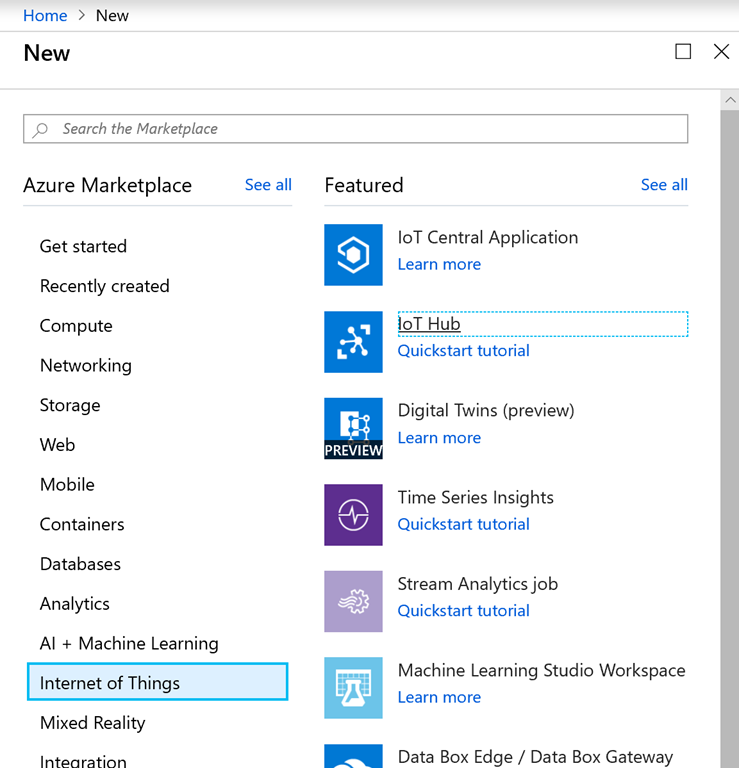
Click the [Create a resource] button (Fig. 1) and select Internet of Things | IoT hub from the menu, as shown in Fig. 2.

ih01-CreateNew
Fig. 1

ih02-Menu
Fig. 2

The "IoT hub" blade displays, as shown in Fig. 3.

ih03-IoTBlade
Fig. 3

At the "Subscription" field, select the subscription in which you want to store this hub. Many of you will have only one subscription and it will already be selected.

At the "Resource Group" field, select a Resource Group in which to store this hub. You can create a new Resource Group by clicking the "Create new" link and entering a name for the new group, as shown in Fig. 4.

ih04-NewResourceGroup
Fig. 4

At the "Region" field, select the geographic region in which you want your hub to be located. Considerations include the location of the devices that will connect to this hub and the location other systems with which the hub will interact.

At the "IoT Hub Name" field, enter a unique name for this hub.

After you have completed the form, click the [Review + create] button. A summary page displays, as shown in Fig. 5.

ih05-iotHubConfirmation
Fig. 5

If any errors display, click the [Previous] button and correct them; Otherwise, click the [Create] button to create a new IoT Hub. It will take several minutes to deploy all the necessary resources and create this hub.

After the hub is created, you can navigate to it, as showing in Fig. 6.

ih06-IotHubOverviewBlade
Fig. 6

The "Overview" blade is selected by default and displays summary information about your hub, as well as links to documentation, so you can learn more about managing and working with this hub.

In this article, you learned how to create a new Azure IoT hub. A hub requires more configuration to be useful. We will cover this configuration in a future article.


GCast 38: Azure Search

Comments [0]

GCast 38:

Azure Search

Azure Search allows you to make your internal data searchable in the same way that search engines like Google and Bing make public information on the Internet searchable.


The Internet of Things (or IoT) has revolutionized the way we think of computing.

In the past, computers were self-contained, general purpose machines that could load complex operating systems, run multiple applications, and perform a wide variety of tasks. They could communicate with one another in order to either share data or distribute workloads.

Now, tiny computers can be found in a huge number of devices around one's home or workplace. When these devices are connected to the cloud, they become far more powerful because much of the processing and storage traditionally done on the computer is moved to the massively-scalable cloud.

At home, refrigerators, thermostats, and automobile contain computers that send and receive information, making them better able to adapt to the world around them.

Businesses take advantage of devices connected to manufacturing machines or vehicles or weather detectors to monitor local conditions and productivity. Capturing data from these devices allows them to respond to anomalies in the data that may indicate a need for action. Imagine a monitor on a factory floor that monitors the health of an assembly line and sends an alert to a repair team if the line breaks down. Or, better still, if the data indicates a strong probability it will break down soon. Imagine a shipping company being able to track the exact location and health of every one of their trucks and to re-route them as necessary.

Industries as disparate as transportation, clothing, farming, and healthcare have benefited from the IoT revolution.

Cloud tools, such as Microsoft Azure IoT Hub allow businesses to capture data from many devices, store that data, analyze, and route it to a particular location or application. As applications become more complex, cloud tools become both more powerful and simpler to create.

These tools offer things like real-time analytics, message routing, data storage, and automatic scalability.

This IoT revolution has enabled companies to capture huge amounts of data. Tools like Machine Learning allow these same companies to find patterns in that data to facilitate things like predictive analysis.

The cost of both hardware and cloud services has fallen dramatically, which has accelerated this trend.

The trend shows no signs of slowing and companies continue to think of new ways to connect devices to the cloud and use the data collected.

The next series of articles will explore how to process IoT data using the tools in Microsoft Azure.


HamiltonCombine a history lesson with great music, great dancing, and a very talented cast and you begin to understand "Hamilton". The extremely popular Broadway musical has been playing continuously at Chicago's CIBC Theater for over two years, and I finally saw a performance Sunday afternoon.

This hype for this show was considerable, but Sunday's performance was up to matching it.

The show's story focuses on the friendship and rivalry between Alexander Hamilton and Aaron Burr. Both were major figures in early American history. Hamilton was the first Secretary of the Treasury, who built the U.S. financial system. Burr was a Senator, a state Attorney General, a Vice President and (spoiler alert) the man who killed Hamilton in a duel.

Some actors got the day off for this matinee performance - most notably, JJ Jeter for Miguel Cervantes as Hamilton and Keith Webb for Akron Watson, but I would not have known I was seeing understudies without looking at the program. Jeter and Webb captured the spirit of their characters - Hamilton's idealism and Burr's ambition - perfectly.

A high point of the interpretation was the character of Thomas Jefferson, who was portrayed as a cocky Prince clone, returning from Paris to set the new country afire.

One of the most interesting aspect of the Hamilton musical is that nearly every major part is played by a person of color - African-American or Latinx. George III was the only speaking role is played by a Caucasian. Of course, the leaders of 18th century United States were almost all white. But this change works well and fits the music, features a lot of R&B and Hip-Hop influences.

I bought tickets to treat myself to a birthday present and I invited my son to join me. We both enjoyed it immensely. I would not be surprised to see this show run for another 2 years in Chicago.


<< Older Posts | Newer Posts >>